Wednesday, May 14, 2008

Interview with Jeri Smith-Ready

BIO

Jeri Smith-Ready (http://www.jerismithready.com) has been writing fiction since the night she had her first double espresso. She holds a master’s degree in environmental policy and lives in Maryland with her husband, cat, and the world’s goofiest greyhound. Jeri fosters shelter dogs with Tails of Hope Sanctuary (http://www.tails-of-hope.org). As of this writing, she has hosted twenty dogs at her home, all of whom have found loving adopters.

Jeri’s latest release is WICKED GAME (http://www.jerismithready.com/wicked-game) (May 13, 2008, Pocket Books), an urban fantasy about a cadre of vampire DJs and the con artist trying to save their ‘lives.’


What was your inspiration for writing WICKED GAME?

A song, of course. Not the song “Wicked Game” by Chris Isaak—that came much later. Almost three years ago to the day, I was driving down the road flipping the dial and came to a classic rock station playing “Bad Company” by the band of the same name. I thought, Hmm, “Bad Company” would be a perfect title for a paranormal book with a shady main character.

By the time I reached my destination, I had a fully formed idea for vampire DJs who were psychologically and culturally ‘stuck’ in the era in which they were turned. I also knew the heroine would be “bad” in some way. (The punch line is that even though it all began with “Bad Company,” the publisher ultimately asked me to change the title.)


Who are your favorite authors and books now and when you were growing up?

I tend to read widely rather than deeply and rarely follow series for more than a book or two, regardless of how much I enjoy them. I’m the opposite of an addictive personality. I’m pretty sure I’d be the world’s first casual crack smoker.

I was completely different as a kid, of course. I read EVERYTHING, especially books by Marguerite Henry, Walter Farley, and Jim Kjelgaard, who each wrote continuing series about animals (and not talking animals, either—usually just plain old horses and dogs). I also loved the Trixie Belden mysteries. Trixie was like Nancy Drew, but with an actual personality.

My all-time favorite book was DOGSBODY by Diana Wynne Jones. It combined my love of animals with my passions for astronomy and mythology. Because of that book, Sirius became my favorite star (not to mention my eventual choice in satellite radio).

My current favorite authors tend to write stand-alone novels or loosely connected series: Neil Gaiman, PC Cast, Charles de Lint, Christopher Moore, James Morrow, Caprice Crane, and John Irving, to name a few. They also tend to be funny.


What is it about fantasy/science fiction that attracts you?

To me, speculative fiction at its core is about what it means to be human. Often it does this by juxtaposing humans with other races or species (like elves or vampires or aliens), or by putting ordinary people in extraordinary settings. I also like the genre’s tendency to push the boundaries of humanity itself.


Why did you decide to make Ciara a con artist?

From the beginning I knew that the main character would have a shady past. Her current job is in sales and marketing (S&M, as she calls it), which is really just a legal form of con artistry. It sounds like a cheap joke, but the two pursuits both require an understanding of human nature and how to manipulate people’s emotions to make them cheerfully act against their own best interests.

Ciara tries to save the radio station from corporate takeover by branding it as “WVMP: The Lifeblood of Rock ‘n’ Roll,” essentially hiding the vampires’ nature in plain sight. She disguises the truth as a marketing gimmick. I loved playing with notions of truth and lies, and I loved watching Ciara’s moral acrobatics in justifying her actions. Con artists are sociopaths with little notion of right and wrong; however, Ciara’s parents gave her a religious upbringing, which she’s rejected, but only on the intellectual level. She still feels guilt.


What (besides writing) do you do for fun?

I’m an avid pro football fan. It’s the only thing in my life that has nothing whatsoever to do with writing, and I guard my time with it like a starving dog with a bone. I also follow politics, but that’s not fun—more like a form of sado-masochistic torture.


What sort of research did you do to write WICKED GAME?

For the musical aspects, the research came by osmosis over the course of months and years. I’d think of a band and then run to Allmusic.com (and more recently Pandora.com) to learn all about them. Then I’d surf the links to understand the connections among that band and its forerunners and followers.

And of course I read books. One of my favorites was THE ROCK SNOB’S DICTIONARY by David Kamp and Steven Daly. Entertaining, informative, and an incisive look inside the mind of the cooler-than-thou rock snob.

To learn about radio stations, I interviewed DJs and had them ‘vet’ the manuscript when it was in near-final form, to make sure I didn’t have any major mistakes. A highlight of my life was getting a cover quote from Weasel, who used to DJ at the legendary Washington, DC, alternative station WHFS. He said that, disturbingly, he could relate very well to my characters.


Shane McAllister (the 90s grunge DJ vamp) loves Nirvana. Is that your favorite band, too?

Yep, though I was only a casual fan during the band’s actual existence. I was sad but not devastated when Kurt Cobain died in 1995. However, as the years go by and I’ve learned to appreciate the band’s incredible talent, I grieve his loss more intensely.

I suppose the creation of Shane is my small way of honoring Cobain’s life and work and the impact it’s had (and continues to have) on my psyche. I feel a spiritual kinship with them both and wonder if but for the grace of good fortune I’d be in as bad a shape as they were in their lives.


What are you writing now?

I’m working on the second draft of WICKED GAME’s sequel, BAD TO THE BONE (May 2009). That’s due to my editor in a few days, which explains the bags under my eyes. And probably the hallucinations.


What does a typical writing day look like for you? How long do you write, that sort of thing?

After three years of writing full-time, I’ve ceased to feel guilty for not writing first thing in the morning. My brain just isn’t wit-enabled before 10 or 11 am.


What is easiest/hardest for you as a writer?

Dialogue is by far the easiest. Maybe it’s my theatre background, but my first drafts tend to consist of characters arguing in living rooms and coffee shops. I keep forgetting that novels have infinite budgets for location shoots.

First drafts are the hardest by far. It feels like sculpting air. Once I have a rough draft down, no matter how crap-adelic, I can work to make it better. But that initial creation of the story is torment.


This isn't your first book; tell us a little bit about what else is out there?

I also have an epic fantasy series, the Aspect of Crow trilogy, which takes place in a world where everyone has magic bestowed by their Guardian Spirit animal. The first one, EYES OF CROW (Luna Books, 2006), won the Romantic Times Reviewers Choice award for Best Fantasy Novel. The second, VOICE OF CROW, came out last October (a favorite of mine because it was the Book That Almost Killed Me), and the trilogy will conclude this November with THE REAWAKENED.

I also have an older urban fantasy (REQUIEM FOR THE DEVIL, Grand Central Publishing, 2001). It takes place in modern day Washington, DC, and Lucifer masquerades as a political consultant. For the first time in his ten-billion-year existence, he falls in love. It changes everything.


What is the purpose of fantasy/science fiction, if any?

See answer to #3. I can’t be that earnest twice in one interview.

More about WICKED GAME: http://www.jerismithready.com/wicked-game

To visit the DJs and listen to a sample of their shows: http://www.wvmpradio.com

Jeri on MySpace: http://www.myspace.com/jerismithready

Ciara on MySpace: http://www.myspace.com/ciarawvmp


Order links

Mysterious Galaxy

Amazon

Barnes & Noble


Simon Haynes is the author of the Hal Spacejock and Hal Junior series (Amazon / Smashwords / other formats)

Tuesday, May 13, 2008

Great service

2000 Hal Spacejock fridge magnets just landed on my doorstep with a groan and a hefty thud. (The groan was the postie. Do you realise 2000 fridge magnets weigh nearly 20kg?)

The printing on the magnets is superb, and I can't wait to get them out to the hundreds of people who sent in their details.

(If you missed out, relax. You can still request some)


Simon Haynes is the author of the Hal Spacejock and Hal Junior series (Amazon / Smashwords / other formats)
Just spotted

No, not Hal 4 (bit early for that!)


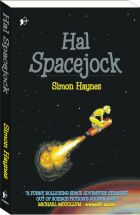
I've just spotted one of the original Bowman Publishing editions of Hal Spacejock on eBay. There are probably less than 100 of these in the wild, so it's a big surprise to see one.

(This was a short-lived cover. Soon afterwards Hal 1 was released with the original Les Petersen cover, and not long after that Fremantle Press picked the series up and the first book was completely rewritten.)

If you're interested, there's a history of the Hal Spacejock books here

Simon Haynes is the author of the Hal Spacejock and Hal Junior series (Amazon / Smashwords / other formats)
Monday, May 12, 2008

Recap #3

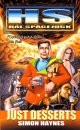
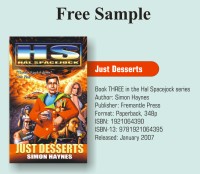
Hal Spacejock Just Desserts (book 3 in the series) was released in January 2007, not much more than a year ago. It's a bit soon to do a recap - much like a 15-year-old publishing their autobiography - but I'll give it a shot.


This was my favourite cover by far. Hal's bemused look of resignation, the glorious reds and yellows, the mercenaries with their OTT guns, the Tastee bars peeking out of Hal's pocket, the crates, the coffee, the racing cars and the crazy dress uniform all relate to plot points and gags in the novel.

The good news started in January ... Hal 3 was a number one bestseller at Fantastic Planet, the first Hal Spacejock novel to hit #1 anywhere.

In July Fantastic Planet posted their all-time top 100 bestselling authors, and I made it into the list at position #34.

Then, in December, Fantastic Planet published their top 50 bestselling books for 2007. (Do these guys love to please their authors or what?) Hal Spacejock Just Desserts was #23 on the list, an amazing achievement when you look at the big names.

During this time there were a number of great reviews for Hal 3, many of them on blogs, and I'd estimate that 85% of the feedback indicated this was the best book yet.

All three books have their fans, each willing to nominate their fave title as the best of the series. The challenge is to write new books they'll enjoy, while remaining fresh AND not coming up with anything so wildly different it's not even Hal Spacejock any more.

Finally, earlier this year Hal 3 was nominated for the WA Science Fiction Foundation awards in the 'Best Long Professional Work' category. Known as the 'Tin Ducks', these awards recognise Western Australians. Much to my surprise, Hal Spacejock Just Desserts won the category.

Simon Haynes is the author of the Hal Spacejock and Hal Junior series (Amazon / Smashwords / other formats)
Sunday, May 11, 2008

New bookmarks

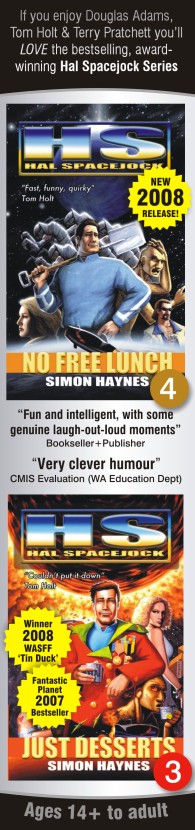
Still working on the artwork for the new Spacejock bookmarks, but what do you think so far?


(These images are from the front & back)

Simon Haynes is the author of the Hal Spacejock and Hal Junior series (Amazon / Smashwords / other formats)
LibraryThing ER

My LT author profile gained a new piccy!


LibraryThing Early Reviewers

Simon Haynes's book Hal Spacejock: No Free Lunch is available from LibraryThing Early Reviewers. Sign up to possibly get a pre-publication copy in exchange for a review.

Simon Haynes is the author of the Hal Spacejock and Hal Junior series (Amazon / Smashwords / other formats)
Saturday, May 10, 2008

Recap #2

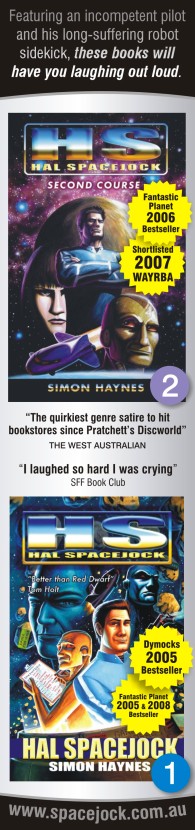
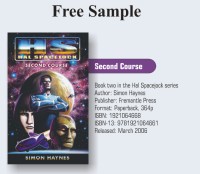
Hal Spacejock Second Course came out in March 2006, just over two years ago, and it's the second book in my short recap of the series.


Now, if there's one issue with Hal Second Course it's this: everyone on the cover looks angry or gloomy. (The same cover artist did the Hal 1, 3 and 4 covers, all of which contain visual gags.)

Not that I'm criticising Hal 2, but I'm eager for the book to sell out so it can be reprinted with a tweaked cover image. The artist will earn a bit more too, so head out and buy Hal 2 now! Quick, stocks are limited, etc.

The book itself earned a bunch of reviews and reader feedback, with plenty of comments along these lines:

I must say that if you enjoyed book one, you'll absolutely love book two - it's miles ahead of book one ... and I loved the first book :)


Next stop was a visit to the Fantastic Planet 2006 bestseller list. From March-December that year they sold enough copies of Hal 2 to earn it position #21 overall.

Next surprise was a nomination for the WA Young Readers Book Awards. Books are suggested by students from schools all over WA, and Hal 2 was accepted as a nomination.

This raised Hal's profile amongst WA school libraries, many of whom purchase large numbers of WAYRBA listed books. A friend of mine working with school & library accounts for a chain store told me she slipped sale-or-return copies of Hal 1 and 3 into every WAYRBA order for Hal 2. With friends like that, who needs a publicity department? ;-)

Then it was Fantastic Planet's turn once again: They published a bestseller list dating back to their opening, and Hal 2 came in at #44.

Simon Haynes is the author of the Hal Spacejock and Hal Junior series (Amazon / Smashwords / other formats)

Friday, May 09, 2008

Recap #1

It's nearly 3 years since the first Hal Spacejock novel was released by Fremantle Press, and sometimes it's easy to forget the milestones and achievements that have cropped up along the way. (It took me over five years to find a publisher willing to take a risk on the Hal books, so forgive me if I occasionally thank my lucky stars in public.)

Anyway, I thought I'd have a little recap of the high points since publication. I can't think of any low points off the top of my head, which is high point number one.

Because there are four books in the Hal Spacejock series, I'll break this into four posts. First cab off the rank: Hal Spacejock, book one in the series.


Published September 2005, appeared in the Dymocks catalogue for that month and hit their SF bestseller list three weeks running. It peaked at #3, one spot ahead of Harry Potter 6. (Relax .. that was the HP6 version with the adult cover. The normal everyday version outsold everything else a bazillion to one.)

Earned out the advance in the first week or two. Admittedly it was a rather small advance, but that's often the case with literary houses.

Generated a large amount of positive reader comments and reviews

Penguin started selling the book into schools across Australia and New Zealand, where it's found a strong following. As a side-effect, this led to quite a number of school, public library and literary festival appearances for the author.

Made #25 on the Fantastic Planet all-time bestsellers list in 2007, and most recently was #8 on their top ten bestsellers for March 2008.

Twelve months after release, Hal Spacejock was reprinted with a new Dion Hamill cover.

Now about to undergo a third printing, and my publisher is considering binding the first chapter of Hal 2 into the back.

There are almost a thousand people on the Hal Spacejock announcements list, many of them eagerly (and impatiently) awaiting news of a US or UK release. (That's one milestone which is still eating a hole in my side.)

It's been a long journey with many speed bumps, but with the upcoming release of Hal 4 (and the possibility of a Hal 5 to come), I can feel the foundations slotting into place. Not finished yet by any means.

Simon Haynes is the author of the Hal Spacejock and Hal Junior series (Amazon / Smashwords / other formats)
Two ASIMs went into a bar...

A public service announcement on behalf of the Andromeda Spaceways co-op, which is zany enough to have me as a member.

Andromeda Spaceways Inflight Magazine issues 33 and 34 are available now as a double package in print or PDF from http://www.andromedaspaceways.com and specialist bookstores.

Two issues, delivered simultaneously!

Not only do you get double your regular dose of fiction from ASIM, you also get stories from Andromeda Spaceways favourites and up-and-coming SF writers.

Edwina Harvey takes the reins for issue 33, delivering her trademark blend of zany and traditional SF fare from a Dragon blogging to tales of ancient breadmaking and betrayal, we'll take you back to the pulp feel of the early SF greats.

Joanne Anderton takes her maiden voyage as editor in issue 34, delivering new piece from favourites Lyn Battersby and Ellie Tupper, outstanding work from up-and-comer R J Astruc, and introducing several new writers for you to enjoy!

Both issues bring you all the enjoyment, entertainment and adventure that every ASIM brings, only twice as much! How can you resist two issues at once?

Issue 33 features fiction by Larry Ferrill, Jeff Parish, Richard S Crawford, Loic Henry, Alex Cohen, Sarah Totton, Simon Petrie (twice!) and Regina Patton, as well as the latest "State of the Art" by Dirk Flinthart and a review of Bruce Boston's Flashing the Dark, by Michael Lohr.

Issue 34 features fiction by R J Astruc. Nigel Stones. M P Ericson. Wade
Albert White, Lyn Battersby, Ellie Tupper, Shana Lear, Tessa Kum
, Poetry by Elizabeth Barrette, as well as a feature on Fantasy from Tehani Wessely, An interview with Jackie Kessler and plenty of reviews.

How do you get it?

Issues 33 and 34 are on sale now at http://www.andromedaspaceways.com in PDF and print versions. Don't miss out, because issue 35 is coming out at warp speed!

And don't forget, ASIM is open right now for submissions of speculative fiction of up to 10,000 words - see our website for guidelines.

Simon Haynes is the author of the Hal Spacejock and Hal Junior series (Amazon / Smashwords / other formats)
Wednesday, May 07, 2008

Still on the old

I check the retrothing.com blog fairly often, and today's entry is a great one:

Kodak's first digital camera

I still remember when home computers looked like that - all string 'n' sealing wax and memory measured in kb. In fact, I have several of them stashed away.

Simon Haynes is the author of the Hal Spacejock and Hal Junior series (Amazon / Smashwords / other formats)

Blast from the past

I was just digging through my old Atari ST files when I came across a plot outline for Hal Spacejock dated 19th February, 1995. It's over 13 years old!

Here are the character descriptions, lifted straight from the text. Those of you who have read the actual book will note how far from the finished versions these two are. (Clunk in the police force? Wow.)


Hal - about 5'8", fair hair, rugged, a bit slow on the uptake, but generous
and friendly (a bit gullible). Impetuous, head strong.

Clunk - advanced stainless steel robot. Has a good command of spoken
language, and a wicked sense of humour. Secretly knows that his breed of
robots is technically superior to all humans. Has a variety of tools and stuff secreted in various pockets around the place. Looks a bit second hand. Actually works for the galactic police, as an undercover drug cop (!)


If you think that's bad, you should read the Feb 1995 version of the novel ...

Simon Haynes is the author of the Hal Spacejock and Hal Junior series (Amazon / Smashwords / other formats)

Tuesday, May 06, 2008

Magnets, Update

This morning I put a page on my site offering Hal Spacejock fridge magnets to anyone sending me an SSAE.

Well, I've just upped the offer, and an SSAE is no longer required:

Hal Spacejock Fridge Magnets


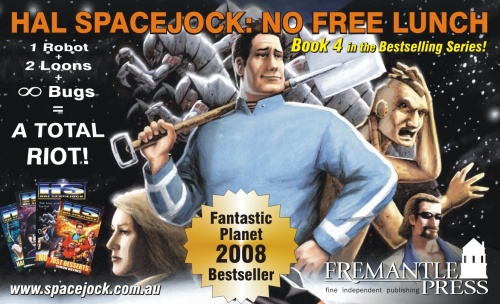
Commissioned to celebrate the launch of Hal Spacejock 4: No Free Lunch. Stick one on your fridge, on your car, on your PC case... who knows, one day they might be valuable.

And the magnets could be worth something, too.

To receive yours, just email me your postal address (Australia only).
(I'll send you 3 or 4 magnets and a couple of bookmarks. Keep one magnet for yourself, and give three away!)

If you live OUTSIDE Australia, send an SAE to:

Hal Spacejock Magnets
c/o Simon Haynes
PO Box 127
Belmont WA 6984
Australia


Include one US$1 stamp or an IRC along with your envelope, but don't stick it on. (I'll attach an Australian stamp instead.)

Conditions:
1. If you live outside Australia, please enclose either a US$1 stamp or an IRC.
2. Your address won't be used for marketing. I'll just be posting the magnets to you, not entering details into a database.
3. If you repost this offer anywhere else, include the URL and a note that people should check it for availability.

Simon Haynes is the author of the Hal Spacejock and Hal Junior series (Amazon / Smashwords / other formats)
Three ...

Three weeks to go until the Hal Spacejock 4 book launch! Invites are being handed out as you read this.

Large batch of Hal Spacejock fridge magnets ordered, and should be here in a week or so. (See the link to obtain yours.)

Early Reviewer packages all but assembled.

Press release plus site & contact list for Big Announcement nearly finished.

More review copies posted (still have three left)

I know, I know. Writers write and publishers do the rest. However, after so many years working in wholesale, with all the marketing that entails, I really do have this stuff in my blood.

Anyway, I want to give Hal 4 a good leg-up before I bury myself in the next book. It's no good throwing a half-hearted effort into these things AFTER the book has been sitting in the shops for several weeks. Everything builds up in the month before the launch, and after that it's all down to the book itself.

Simon Haynes is the author of the Hal Spacejock and Hal Junior series (Amazon / Smashwords / other formats)

Saturday, May 03, 2008

Interview with Kelly McCullough

Kelly McCullough's first novel in the WebMage series, WebMage, was released by Ace in 2006 to considerable critical praise. A second, Cybermancy, followed in 2007. His newest release, CodeSpell, will be out May 27th. And a fourth book, MythOS, is slated for late May '09. His short fiction has appeared in numerous venues including Weird Tales, Writers of the Future, and Tales of the Unanticipated. His illustrated collection, The Chronicles of the Wandering Star, is part of a National Science Foundation-funded middle school science curriculum, Interactions in Physical Science.

For more information and samples of some his short stories you can check out his website: http://www.kellymccullough.com/. Kelly blogs regularly on writing topics at http://wyrdsmiths.blogspot.com/ along with several other members of his writing group including well known authors Eleanor Arnason, Tate Hallaway/Lyda Moorhouse, and Naomi Kritzer. He also occasionally posts at http://sfnovelists.com/ – usually on the 9th of any given month.

Why this book? What made you want to write this story?

That's a surprisingly difficult question to answer. This is the third book of a series and certainly part of my motivation for writing it is that this is a fun world to play in and I like these characters enough to want to spend more time with them. Part of it is that I had what I thought was a fast fun plot that continued the story in a way that would be entertaining to write and to read. But probably the most important part of the equation for this book is that actions have consequences. The things that Ravirn did in books one and two have ongoing repercussions and I wanted to see how they played out and how Ravirn would have to grow to respond to them.

Which authors inspire you? Has that changed over time?

Different writers teach me different things at different times. Zelazney and Tim Powers are probably at the top of the list of writers who've affected my work most visibly, though Powers is less present in the WebMage stuff than he is in some of my other, darker work. Norton and McCaffrey and Tolkien are in my bones. Martha Wells is wonderful and so are Robin McKinley and Lois McMaster Bujold.

Why genre? Is there something special about science fiction or fantasy that draws you to write in the field?

I was pretty much raised to be a fantasy and science fiction writer, though that certainly wasn't the intent of the process. I'm a third generation fan of the genre and some of my earliest memories are of having the Lord of the Rings, Asimov's Foundation trilogy, and A Midsummer Night's Dream read to me. I learned very early to love story and genre and once I found out that I could maybe make a living by telling the sorts of stories that were told to me I was pretty much lost.

What do you find most interesting about Ravirn? Why write about this protagonist?

What I love about Ravirn is his combination of idealism and cynicism. He expects the worst of a situation but won't let that stop him from working toward a solution, even when he knows the attempt is probably doomed. That and his sense of humor. I come from a family where humor, particularly black humor and sarcasm, are fundamental coping mechanisms. Sometimes life hands you a situation where you have to laugh or cry, and given any choice in the matter I'll always pick laughter. It may not solve the problem, but it sure lightens the load.

You're a writer. What else are you? What are your interests? Hobbies?

Husband and cat-wrangler are probably at the top of the list for other self-identifiers. My wife and I are coming up on twenty fantastic years together and over that time two cats became three cats, became four cats, became five. I love to read and play video-games. I've got a Gaiman, a Pierce and a Blaylock on the active books pile and I just finished playing Portal and Drake's Fortune. I also like hiking and biking, and since it's spring, I'm at the front end of the annual garden madness.

Did you have to do any special research for this book? What did you need to know in order to write it that you didn't know before? Do you have some special preparation you do for your writing?

I didn't have to do a lot of new research for this book. After finishing two novels set in the Greek gods plus computers reality of the WebMage I have a pretty good grounding in this world, and I really only needed to touch up my memory of a couple of the myths involved in this specific story. On a more general note, I read non-fiction voraciously. I just finished a great book on plants in traditional Hawaiian culture as part of a Hawaiian history and mythology kick. I read several science and technology magazines on an ongoing basis and I'm looking around for some good references on the Canadian Maritime provinces in general and on Halifax in particular.

I see a lot of computer and programming stuff in the WebMage series. Is that something that really interests you? Or is it more driven by the needs of the story?

Mostly it's the needs of the story. I love my laptop and the web and I tend to be a technology early adopter if I can afford it, but I'm not really much for programming or hacking. While I have been immersed in computer culture from a very early age since my mother became a bug-checker when I was about ten and has been working as an analyst and programmer ever since and because I've got a lot of close friends in IT, it's not something I'm much involved in outside of writing the books.

Ravirn displays a lot of physicality, constantly getting himself into life-threatening situations and back out of them in ways that involve all sorts of death defying action. I'm guessing that's not something you the writer have an enormous amount of experience with. How do you make that convincing? Do Ravirn's solutions reflect the sort of things you might do in a similar situation?

I'm much more of a thinker than Ravirn, especially as I've gotten older, but I've got to admit to a certain amount of speaking from experience when I have him do something big and physical and stupid like climbing a building and then jumping off. It's not the sort of thing I'd do now, but when I was in my late teens and early twenties I was something of an adrenaline junkie. I was into martial arts and mountain climbing and all sorts of things that are moderately safe when done responsibly and less so when done the way I did some of them. From fifteen to twenty-two I averaged two trips to the emergency room a year, and as I've gotten older that's led to things like a couple of knee surgeries and other corrective measures.

What are you writing now?

A couple of things. I just sent off book proposals for a fifth WebMage and for two books that I would like to write as a successor series to the WebMage/Ravirn books. I've also got a YA I want to work on–the second in a series that my agent is shopping around now–because I'm in love with the story and the world. That's the main front burner stuff. But I've got five complete novels and nine proposals out with various editors and any of those could get moved up the list if they sell. I'm pretty busy at the moment, and I love it that way. There's really nothing I'd rather be doing with my life than what I'm doing right now.

How did you become a writer? Is this what you saw yourself growing up to be? Or did it take you be surprise?

Short answer: I quit theater. Longer version. I set out at the age of eleven to be an actor and was well on my way when I met the woman I would eventually marry. At that point, I realized how incompatible theater was with having a long term relationship and I went looking for something else to do. On something very like a whim I wrote my first novel and fell head over heals in love with writing. Now I can't imagine myself doing anything else.

Do you have a writing routine? Talk process for a moment, how do the words get on the page?

I write between two and eight hours a day five days a week. On a typical day I get up around eight in the morning, stagger downstairs and collect a unit of caffeine–could be soda, could be tea, it doesn't really matter since it's a delivery system. Then I hop on the treadmill and websurf and read email and the like for an hour or so. At that point I'm mostly awake and I do things like respond to the email or other writing and life maintenance tasks. That can take anything between twenty minutes and two hours. Then I write. Less than a thousand words is a bad day. More than two thousand is a good one. Oh, and, I use a laptop so that I can work where the whim takes me.

Office? Closet? Corner of the living room? Do you have a set place to write? A favorite? How does the environment you write in affect your production? Your process?

In summer I write in a second floor screen porch. It has a gorgeous view over the park that abuts our backyard, and that sort of near outdoor setting is my preferred setting for writing–I'm hoping to have a more permanent solar built to replace the porch soon. Until then, my winter office is our upstairs sitting room which gets southern light and is a pretty comfortable substitute for my screen porch.

Is there anything you especially like to work on in a book? Anything you hate?

I love world-building and plot-twisting. Figuring out how a system of magic might work and then figuring out ways to game that system fascinates me. And yes, I was a rules lawyer back in my role-playing days, why do you ask? Likewise building a plot and then coming up with ways to add twists or bits of misdirection is a joy for me. I don't really have any hates. There are things that I used to find more difficult, character chief among them, but I'm getting a steadily better handle on the whole process and I just love writing. I even love rewriting, both the sentence level stuff and the bigger more complex story edits.

This isn't your first book; tell us a little bit about what else is out there.

Well, primarily it's the WebMage stuff. WebMage, Cybermancy, and now CodeSpell with MythOS finished and forthcoming and a proposal in for SpellCrash after that. On the novels front, as I mentioned above, I've got five more books and nine proposals out, so that could change at any moment. I've also had a number of short stories published, including an illustrated collection as part of a big middle school physical science curriculum that's been adopted by several states. But that doesn't make an enormous amount of sense outside the classroom setting it was written for.

Do you see fiction as having a purpose? Generally? How about your own work?

Transcendence. I think that human beings need story. We need myths and legends and tales that lift us out of ourselves and that fiction supplies that need. That's another reason I do most of my work in fantasy-if I'm going to be a mythmaker for a living I might as well write the truly mythic.


Sales info:

Amazon: CodeSpell, Cybermancy, WebMage

Barnes & Noble: CodeSpell, Cybermancy, WebMage

Dreamhaven: signed copies

Simon Haynes is the author of the Hal Spacejock and Hal Junior series (Amazon / Smashwords / other formats)
Thursday, May 01, 2008

Another Hal 4 review

I had a lot of fun writing this book, even though it involved months of very hard work. So, it's good to see a couple of positive early reviews:


The plot is cleverly engineered so that the lives of seemingly unrelated characters are thrown together in the most unlikely of circumstances which, on reflection, seem perfectly logical. And, of course, trouble is never far away.

...

Haynes has cranked up the ‘ribald meter’ a notch or two as well, and there are plenty of coy sexual references and double entendres. You could hardly call this racy, however; it’s all good, clean fun.

...

The Hal Spacejock series is highly amusing and addictive fare, and I can wholeheartedly recommend it to anyone.

Full review here

(The book won't be out for 3-4 weeks yet, but that gives you plenty of time to pick up and read the first three, doesn't it?)

Simon Haynes is the author of the Hal Spacejock and Hal Junior series (Amazon / Smashwords / other formats)
Wednesday, April 30, 2008

Hal Spacejock 4 Review

The Specusphere has posted their review of Hal Spacejock 4: No Free Lunch. Lots of nice things said about the book, which is always a positive.

I've also knocked up a very quick book launch invite for family & friends. (The publisher is doing a proper one, but I don't get many of those and I like to hand things out nice and early.) Click the image for a bigger size. Or better still, come to the launch.


I've also decided against bookmarks for Hal 4, and instead I'll be doing a batch of rubber fridge magnets. (Although how people are supposed to stick a magnet on a rubber fridge is beyond me. And who keeps rubbers in the fridge, anyway? Do they really want to be THAT cool?)

This is the current draft of the magnet artwork, because, well, I like to share my work:


Would you stick one of these babies on your rubber fridge?

*EDIT* Whoever pre-ordered Hal 4 from Amazon .. you're a champ. Hope you like the book!

Simon Haynes is the author of the Hal Spacejock and Hal Junior series (Amazon / Smashwords / other formats)
Tuesday, April 29, 2008

Interview with Jenna Black

Jenna Black is your typical writer. Which means she's an "experience junkie." She got her BA in physical anthropology and French from Duke University.

Once upon a time, she dreamed she would be the next Jane Goodall, camping in the bush making fabulous discoveries about primate behavior. Then, during her senior year at Duke, she did some actual research in the field and made this shocking discovery: primates spend something like 80% of their time doing such exciting things as sleeping and eating.

Concluding that this discovery was her life's work in the field of primatology, she then moved on to such varied pastimes as grooming dogs and writing technical documentation.


Without any further delay, I present an interview with Jenna Black, whose novel HUNGERS OF THE HEART is released today.

What was your inspiration for writing HUNGERS OF THE HEART?

Since the first book of the Guardians of the Night series,
I’ve always known I would eventually write Drake’s book. Many of my readers
have also impatiently been awaiting his book since they first “met” him in
WATCHERS IN THE NIGHT. As excited as I was to write his story, though, it
turned out to be very hard to do. One of the most attractive things about Drake in WATCHERS was his self-confidence, the sense that he was comfortable in his own skin. Confident, comfortable characters, however, don’t make for interesting protagonists, so I had to shake him up. I found myself strangely reluctant to do so. That was the first time I had to struggle to make myself be mean to one of my characters. Usually authorial cruelty comes easily to me, as my readers no doubt know!

Which books and authors have most influenced your career?

I’d have to credit THOSE WHO HUNT THE NIGHT, by Barbara
Hambly, as being the book that piqued my interest in vampires. The main vampire character in that book, Don Simon Ysidro, is absolutely fascinating to me. There’s no question he’s a bad guy—all her vampires are killers, and none of them seem to feel any remorse for their actions. However, Don Simon also has redeeming qualities, such as a sense of honor, that make him at least somewhat sympathetic to both the reader and the novel’s hero. (And from that description, you can no doubt see how much I was influenced by that particular book!)

For my urban fantasies, I’d have to credit the Anita Blake series, by Laurell K. Hamilton as having had the most influence. That was the first urban fantasy series I read, and I ended up absolutely hooked. After reading her books, I went on to “discover” such authors as Kelley Armstrong, Keri Arthur, Rachel Caine, and Patricia Briggs. It was because I loved all those books so much that I set out to write an urban fantasy myself.


What’s the best and the worst advice you’ve ever received?

The worst advice I ever received was to slavishly follow all publishers’ guidelines for submissions. (Note the word “slavishly.” I’m not saying to ignore guidelines.) For the 16 + years I was seriously trying—and failing—to get published, I dutifully submitted books one at a time,
no simultaneous submissions. I can’t tell you how many times I had to wait a year or more to get a response. And during that waiting time, I refused to submit the book to another publisher, because most publishers say they won’t accept simultaneous submissions. It made for a painfully slow, agonizing, frustrating process. If I had it all to do over again, I’d probably go ahead and make simultaneous submissions despite the guidelines. I think it would have saved some of my sanity.

The best advice was for me to take responsibility for my own career. This meant always acting as though my career was under my control, even when sometimes it feels like I’m a victim in the winds of fate. This advice was crucial to my finally getting published. I had gotten to a point where I’d convinced myself I needed to get that lucky break to get my foot in the door. And that was a dismal prospect, because you can’t control luck. Then I went to a workshop where the teachers were adamant in their belief that luck has nothing to do with it, that if you write well enough and long enough, you’ll break in. It was a total change of attitude for me, and it
changed the way I approached my career. When I began to believe that it was my own abilities, not the whims of luck, that would ultimately get me published, I started working much, much harder at my writing. I started treating it like a career, rather than a hobby. A year later, I had an agent. Two years later, I had my first contract. And now I have five books out with four more under contract. So it was by far the best advice I’ve ever received.


What (besides writing) do you do for fun?

Number one on my list is, naturally, reading. Like most writers, I’m a voracious reader. I’ve recently become addicted to doing jigsaw
puzzles. My enjoyment of jigsaw puzzles has come and gone multiple times over the course of my life. I’ll go for years without doing one, then suddenly I’ll have an urge and I’ll do a whole bunch in a row. I’m finding them particularly fun right now because they’re something I can do that doesn’t involve sitting in front of a computer.

I also enjoy ballroom dancing, which I’ve just taken up
again after several years’ hiatus. I think it’s important for me to find things to do outside the house now that I’ve quit my day job. It would be so easy for me to become a hermit. So that’s why I decided to start dancing again. (Though it’s also a lot of fun as well as being good exercise.)

What are you writing now?

Right now I’m working on the fourth book in my Morgan Kingsley series. I’ve
just gotten started, so I’m still in those very uncertain “what the heck is
going to happen in this book?” stage. It often takes me a few chapters before I start feeling like I’ve “really” started the book. I’ve also been playing around with an idea for a YA urban fantasy, but I have to put that aside now to work on the book that’s sold and on deadline.

Did you always want to write? Or did you stumble into it? How did you get where you are now?

I wrote my first book when I was in fifth grade. It was an autobiography. It’s written in pencil, with crayon illustrations and a construction paper cover. So I’ve pretty much been writing forever. I wrote my first novel my senior year of high school for my English class on creative writing. (Actually, it was really a novella, but I considered it a novel at that time.) I then wrote my first real, full-length novel in college. However, it took about 20 years and 17 more novels before I made my first sale.

In college, I majored in anthropology and French. My
intention was to get a PhD in physical anthropology and become the next Jane Goodall. Obviously, my career and my ambitions ended up taking a different path.


What does a typical writing day look like for you? How long do you write, that sort of thing?

I start out by trudging up to my computer while guzzling coffee as I
try to shake the sleep clouds from my head. (I’m not the best morning person in the world.) I usually read emails and look at some of my favorite Internet sites (like MySpace and Romance Divas) while I wait for my brain to be fully functional. Then I drag myself to a computer that has no Internet access and no games—nothing installed on it other than word processing software. And I write.

I tend to write in multiple short (45 minutes to an hour) spurts throughout the morning and early afternoon. Between spurts, I check email or do chores or work out. (Or goof off, but I try to keep that to a minimum.)

Where do you write?

I have a home-office-cum-library where I work. It’s a converted bonus room over our garage, and it’s decorated to help stimulate my imagination—and give me the illusion that I’ve actually left the house to write. The effect is like working in a medieval/gothic library, with faux-wood floors and faux-stone walls.

What is the best part of being a writer? The most frustrating?

The best part about being a writer for me is hearing from
readers. I love knowing that people have read and enjoyed my books. I was
especially moved when I got an email from a reader who was seriously ill and told me my books helped make the bad times better for her. Books have always been my escape during the worst times in my life, and one of the thoughts that kept me going while I was struggling to sell that first novel was the desire to provide that same kind of escape for others. Learning that I’d done so for at least one reader brought tears to my eyes.

The most frustrating part of being a writer is how many things about your career are not under your control. You can’t control the whims of the market, the editorial shifts in your publishing house, the closing
of lines, the cover art, the marketing . . . You name it. (Some of those things you can control when you’re a mega star, but I’m not there yet!)

This isn't your first book; tell us a little bit about what else is out
there?


There are three other books out in the Guardians of the Night series: WATCHERS IN THE NIGHT, SECRETS IN THE SHADOWS, and SHADOWS ON THE SOUL. There’s also THE DEVIL INSIDE, the first book in my Morgan Kingsley, Exorcist series. The second book in that series, THE DEVIL YOU KNOW, will come out on July 29.

Where can we learn more about you and your books?

My website is www.JennaBlack.com You can also find me on MySpace at www.MySpace.com/jennablackbooks

Simon Haynes is the author of the Hal Spacejock and Hal Junior series (Amazon / Smashwords / other formats)

Tate Hallaway interview


Tate's Bio:


Tate Hallaway is the best selling alias of the award-winning science fiction author Lyda Morehouse.  Lyda wrote a four book trilogy about angels, computers and the end of the world all of which are currently out of print, though she still writes and publishes science fiction/fantasy/horror short stories.   Tate’s books are all in print with more in the Garnet Lacey series in the works.  You can find both Lyda and Tate all blogging all over the internet including places like LiveJournal, Blogspot, MySpace, Facebook, and even YouTube.  “They” live in Saint Paul, Minnesota with five cats, a five year old son, and many, many fresh water fish.


Blurb for Romancing the Dead


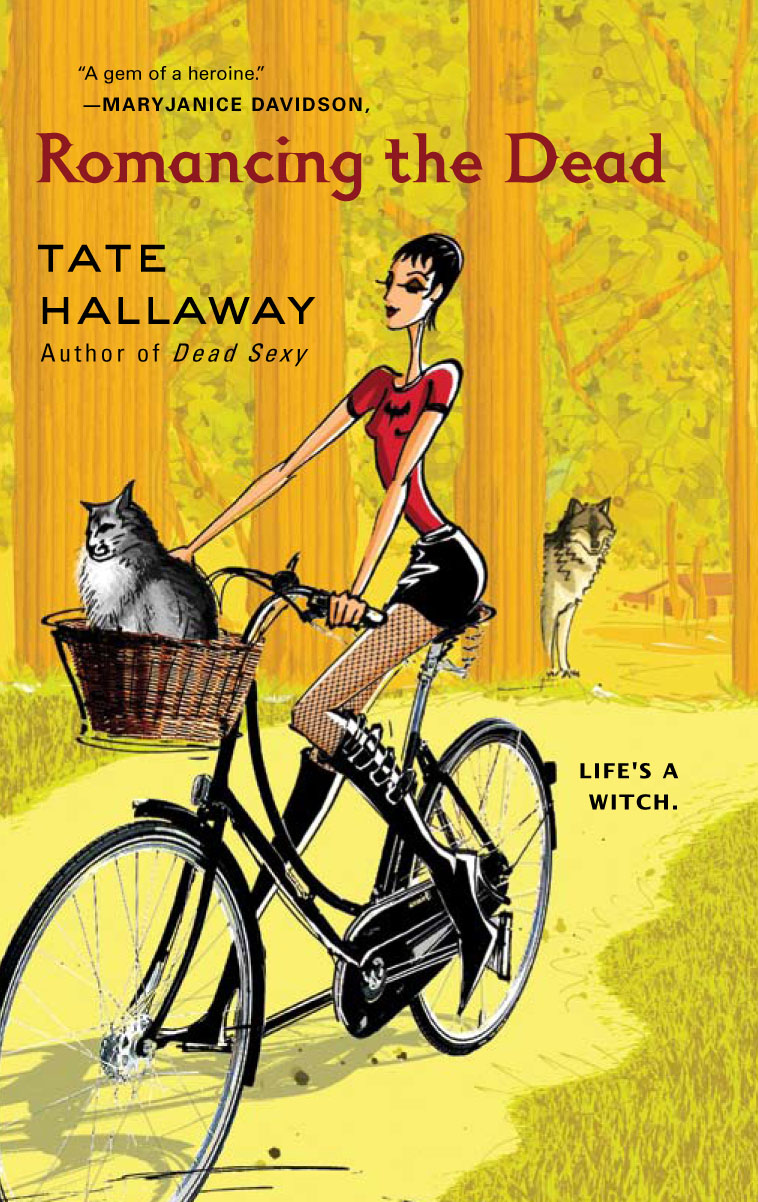
It’s been one heck of a week for Garnet Lacey. The Vatican witch hunters finally think she’s dead, the FBI has closed their file on her, she’s co-founding a new coven—and the gorgeous vampire she loves has just asked her to marry him. How lucky can one girl get?

Then, her fiancé goes missing and Garnet’s worried sick. Has he been kidnapped? Or could he have run off with that blonde from the coven? Now Garnet will have to seek the help of her future stepson—the same brat who turned her over to the witch hunters for a brand-new Jaguar. But there’s more bad news: the Goddess Lilith, who camps out in her body, has been making embarrassing appearances. And on top of that, some killer’s on her tail...
 
 
INTERVIEW
 
What was your inspiration for writing ROMANCING THE DEAD?


ROMANCING THE DEAD is the third book in my paranormal chick-lit Garnet Lacey series.  People often ask me how I, as a writer, stay inspired when writing about the same characters.  I think I could get pretty bored if I didn’t allow my characters not only to be human (and thus full of flaws), but also to change and grow. 


A lot of the romance I read when I first started reading romances were “first blush,” as in the main point of the story was the excitement of meeting someone new.  At the end of these novels, things faded very quickly into the nebulous (and unrealistic) happily, ever after.  One of the things I’m trying to do in the Garnet Lacey series is promote the romance that can be found in a long-term relationship.  I mean, Garnet is in love with a vampire, for goodness sake.  You don’t get more “ever after” than that.   I, myself, have been together with my partner for more than twenty years, and I don’t think those kinds of relationships get a lot of glory in romance novels, you know?


Plus, in every novel I like to take on one of the tropes in urban fantasy and do my own thing with it.  In this book, I have Garnet meet someone who may or may not be a werewolf.


Who are your favorite authors and books now and when you were growing up?


Currently my favorite authors are writing graphic novels.  I’m in to Brian Michael Bendis’ NEW AVENGERS.  I just finished reading NEW AVENGERS: ILLUMINATI in preparation of the up-coming Secret Invasion.  I’m also a huge fan of Ed Brubaker’s CAPTAIN AMERICA, particularly his WINTER SOLDIER stuff.  Comic books haven’t been this fresh for me since I first picked up Stan Lee and Jack Kirby’s FANTASTIC FOUR when I was a kid.


For more traditional fare, my favorites are Rachel Caine, who writes the Weather Warden series, and Kristin Katheryn Rusch who writes the Disappeared series, which is a kind of futuristic a police procedural set on Mars.  When I was growing up my favorite authors were Katherine Kurtz and Anne McCaffrey. 


What is it about fantasy/science fiction that attracts you?


The explosions.


Seriously, I was talking to a friend about this at a bar the other night, and I confessed that one of my favorite things about writing paranormal romances/urban fantasy is that you get to have all the relationship/girly stuff married to the high-octane adventure/boy stuff.  That’s pretty near perfect for me.


Why did you decide to make Garnet a Witch?


Because I am.


And it can be very difficult to find realistic portrayals of Wiccan religion in novels.  One of the things that drives me crazy in movies and TV shows like “Buffy, the Vampire Slayer” is when a complete novice reads a spell they find in a dusty book and they conjure a demon without breaking a sweat. 


Of course, because the Garnet Lacey series is fantasy, I take liberties, too.  Real-life witchcraft can be pretty dull.  The scope of Garnet’s power is a lot stronger than anything I’ve experienced in real life, but I try to show ritual as part of her daily practice as well.  In other words, she doesn’t just cast spells, but she also prays to a Goddess and observes the cycle of the seasons, like the real witches I know. 


What (besides writing) do you do for fun?


I’m an aquarist.  I have four fresh water fish tanks in my house and have had over the course of a year:  powder blue dwarf gourami, neon tetra, bettas (a spawning pair), a white cloud minnow, yellow tuxedo guppies, and several goldfish (comet and shubunkin).  I’m so into it I read fish magazines and occasionally write long, boring blogs about my fish triumphs and woes on my livejournal:  [http://lyda222.livejournal.com].  My betta Johnny/Giant-Girl is even a YouTube star:  http://www.youtube.com/watch?v=x9Gg0mfEfTw.


What sort of research did you do to write this book?


Well, because I’d decided to play around with the urban fantasy trope of werewolves and the story takes place in Madison, Wisconsin, I did a little research and discovered that Wisconsin has its own werewolf myth: “the Beast of Bray Road.”  There’s a book about it by LInda S. Godfrey called BEAST OF BRAY ROAD: TAILING WISCONSIN'S WEREWOLF.


Garnet loves astrology. Is that your favorite thing too?


One of them.  Just like Garnet I’m an amateur astrologer. Yeah, we’re talking about predictions and horoscopes and stuff.  No, I don’t think the stars rule my destiny, but, yeah, I think it’s all a very fascinating and entertaining way to look at life and relationships.  


I love astronomy, too.  My friend Rachel takes me and my four-year old out star-gazing on clear nights.  The science fiction fan in me loves seeing the rings of Saturn and such.


What are you writing now?


There’s more Garnet Lacey in the works.  I’m currently putting the wraps on book four, DEAD IF I DO, which I like to describe as “The Wedding Planner” meets “Night of the Living Dead.”


Did you always want to write? Or did you stumble into it? How did you get where you are now?


It took boredom to turn me into a writer. 


True, I was an English major in college, but other than dabbling a little in fanfic as a teen I didn’t really do a lot of creative writing.  After college, I had a series of dead-end secretarial jobs and really didn’t require a whole lot of my brain power.  One of these jobs didn’t even come with a computer, but when I incessantly bugged my boss for work she taught me the art of the slack.  She said, “Sometimes it’s important to LOOK busy.”  So, I started typing letters home to friends.  The letters turned into little silly stories, limericks, and finally, the beginning of my first novel, Sidhe Promised, which has never been sold.


Someone either a friend or my partner talked me into taking a science fiction writing class at the Loft http://www.loft.org  I had an awesome teacher who taught us the art of critique and encouraged us to form writers’ critique groups outside of class.  The one I formed from that class with my friend and fellow writer H. Courrage LeBlanc, Wyrdsmiths is still going strong today, nearly twelve years later.  If you want to check out the "life" of a writers' group, we have a blog: http://wyrdsmiths.blogspot.com


Eventually, through a friend of a friend I got my second novel, Archangel Protocol, under the nose of an agent.  The rest, as they say, is history.


What does a typical writing day look like for you? How long do you write, that sort of thing?


Well, I’m in crunch time now, so I write close to four hours a night, from about 8:00 pm to midnight.  Normally, however, I tend to clock closer to only a couple of hours, if that.  I have a full-time job as a mom, so my writing time doesn’t start until everyone is fed and tucked in their beds.  When not writing under a deadline, I also take weekends off.


Hm, which may explain why I'm in crunch time now, eh?


Where do you write??


Wherever my laptop is.  I tend to write propped up in bed or on the couch in the TV room. 


What is easiest/hardest for you as a writer?


I’ve always found dialogue the easiest to write.  That’s probably because it’s the part I practice the most.  Not only do I love to talk, but also when I’m falling asleep at night it’s the fictional conversations that I play with in my head. 


As for hard, that would be plot.  If I had my druthers, no one would do anything.  They’d all sit around in a coffee shop and argue.


This isn't your first book; tell us a little bit about what else is out there?


Though all of them are meant to stand more-or-less on their own, there are two previous Garnet Lacey books:  TALL, DARK & DEAD and DEAD SEXY.  Both follow the exploits of Garnet Lacey, a Witch who accidentally drew in the dark and murderous Goddess Lilith to protect her coven from attack by Vatican witch hunters.  When the stories start, she’s on the run and trying desperately to give up witchcraft, which Lilith (and, consequentially, she) crave like a drug.  Tall, dark and dead Sebastian Von Traum comes into the bookstore the Garnet manages and, as they say, hilarity ensues. 
And explosions… or at least zombies.


There’s an excerpt of the first chapters of all three books available on my website  http://www.tatehallaway.com.


Other useful stuff:


Amazon.com links to Tate's books:

Romancing the Dead:  http://www.amazon.com/Romancing-Dead-Garnet-Lacey-Book/dp/0425221334/

Dead Sexy (Garnet Lacey #2): http://www.amazon.com/Dead-Sexy-Garnet-Lacey-Book/dp/0425215083/

Tall, Dark & Dead (Garnet Lacey #1):  http://www.amazon.com/Tall-Dark-Dead-Garnet-Lacey/dp/0425209725/


Places to find Tate on the Web:

Website:  http://www.tatehallaway.com
Blog:  http://tatehallaway.blogspot.com
Wyrdsmiths group blog: http://wyrdsmiths.blogspot.com
Fangs, Fur & Fey (group blog for paranormal romance writers): http://community.livejournal.com/fangs_fur_fey/
MySpace: http://www.myspace.com/tatehallaway


Simon Haynes is the author of the Hal Spacejock and Hal Junior series (Amazon / Smashwords / other formats)

Monday, April 28, 2008

Last one for today

I've been away for a week, which explains the sudden flurry of posts on my blog. I have a bulging inbox, mail file and clipboard full of notes to get to, so I'll probably be silent for another week while I try desperately to catch up.

Anyway, we've settled on a date and time for the Hal Spacejock 4 book launch:

Where: Dymocks Cannington, Westfield Carousel Shopping Centre
When: 27th May at 6:30pm
RSVP: Dymocks on (08) 9356 8888 (Trading hours & contact details here)

That's in Perth, Western Australia for all you overseas blog readers. This is what it looks like from (way) above:


View Larger Map

Simon Haynes is the author of the Hal Spacejock and Hal Junior series (Amazon / Smashwords / other formats)

Hal 3 review

The “Hal Spacejock” books are funny, very much in the tradition of “Red Dwarf” and “The Hitchhiker’s Guide to the Galaxy,” but there are plenty of things that make them different, and in some facets superior, to those famous titles.

This isn’t a gaudy, exotic, higher-state-of-consciousness type SF future; it’s a run-down, penny-pinching, two-bit swindling kind of future, and Hal Spacejock is often the biggest swindler of them all.


Full review here (Minor spoilers included)

Simon Haynes is the author of the Hal Spacejock and Hal Junior series (Amazon / Smashwords / other formats)

Measuring success

There are several ways to measure the success of a novel - and good reviews and appearances in bestseller lists don't really define the kind of success publishers are looking for. Sure, they're great when they happen, but you still have to shift the bulk of the print run to make any money, and a two-three week splash after release isn't enough to do it.

Because stores can return unsold books (within reason), initial orders for a particular title don't really tell the publisher a whole lot. If they print 5000 copies and ship 3000, there's a good chance 20-50% of them will come back for credit at some stage. (Publishers would prefer that books be non-returnable, but the problem with hard sales is that bookstores then order 1/2 to 1/3 what they'd take IF they could send them back again. And a big pile of copies in-store is a far more effective sales tool than nifty bookmarks or expensive press adverts.)

Back to the point. If a publisher prints X thousand books and sells the lot, then prints another x thousand and sells those too, THAT's success on their terms. In other words, second printing, third printing .. I like to think of it as going back to the goose for more golden eggs ;-)

I don't often post without mentioning Hal, so you can probably see where I'm going with this ... yes, my publisher just informed me that they're ordering a third printing for the first Hal Spacejock book. Now we can talk about Hal Spacejock 5 ;-)

And with every reprint, and every new Hal book, the price of the series to overseas publishers is going up, and up, and up ...

Simon Haynes is the author of the Hal Spacejock and Hal Junior series (Amazon / Smashwords / other formats)

Saturday, April 19, 2008

P-p-pick up a penguin

Just found this on my daily trawl through the web:

"Do you have what it takes to write a commercial crime/thriller novel? If so, enter our Penguin Crime Writing Competition and if you are judged the winner by our expert panel you will be published by Penguin Australia."

(Open to Australian residents)

Penguin Crime Writing Competition

Entries close 23rd June, and you can read the terms & conditions on the competition page. A quick scan shows they're only after the first few chapters (up to 5000 words), plus a complete synopsis with the estimated final word count. In other words, it doesn't look like you need a completed manuscript to enter (he says underhandedly)

Not a bad looking contest at all.

Simon Haynes is the author of the Hal Spacejock and Hal Junior series (Amazon / Smashwords / other formats)

Hal 1 review

Rarely have I read a book that was simultaneously so amusing and so warm-hearted. Humour usually revolves around laughing at the misfortune of others, but there’s precious little nastiness here. This is an excellent novel, and I would recommend it to anyone.

Book Review - Hal Spacejock by Simon Haynes

Simon Haynes is the author of the Hal Spacejock and Hal Junior series (Amazon / Smashwords / other formats)

Friday, April 18, 2008

LibraryThing coolness

Today I discovered LibraryThing has added venues and events to their database. Users add their favourite bookstores, with links, and if you specify a location in your LT profile you can get a list of nearby bookstores, with ratings, and also any upcoming events in those stores.

Just go to www.librarything.com/local to see the results in action. You even get a Google map of the bookstore location.

All very web 2.0

I stuck Fantastic Planet and Dymocks Carousel in the database, since both stores have been kind to the Hal books. If you're on LT and have a fave local store, why not add them in too?

Simon Haynes is the author of the Hal Spacejock and Hal Junior series (Amazon / Smashwords / other formats)

Thursday, April 17, 2008

Chapter One Samples

Below you'll find a double-sided flyer for each novel in the Hal Spacejock series. Each contains the complete first chapter of the relevant book, along with a cover shot and publication details.

Some suggested uses:

• School librarians could use them to tempt reluctant readers.
• Bookstores could leave a few on the counter*
• Bookstores could tuck the next flyer into the previous book.
• Keen Hal Spacejock fans could give them to friends & fellow SF aficionados.
• Dedicated Hal fans could put a few on the leaflet table at the next con.
• Rabid Hal fans could hand them to total strangers in shopping malls.


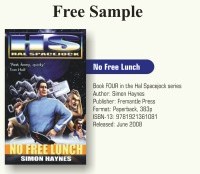
Hal 1 Free Sample Flyer   Hal 2 Free Sample Flyer Hal 3 Free Sample Flyer   Hal 4 Free Sample Flyer

One side is colour, the other monochrome. I print the mono side on my laser first, then flip them over and run them through the inkjet (borderless printing) for the colour.

These are three-fold leaflets - fold the back flap in towards the middle, then fold the cover over it.


* Because we ALL know how much empty space there is on a bookstore counter ...

Simon Haynes is the author of the Hal Spacejock and Hal Junior series (Amazon / Smashwords / other formats)

Wednesday, April 16, 2008

Publication blog

I promised to blog about non-sekret communications with my publisher, giving you an insight (hopefully) into the process.

I can't talk about this or that or even the other, but I can mention that I'm meeting with Clive and Claire from FP next week to discuss a major publicity idea for Hal Spacejock. (My idea of having a lifesize Clunk crash all the breakfast TV shows fell on deaf ears. It seems they're already hosted by expressionless old robots, so another one barging in wouldn't raise any eyebrows.)

I can't even discuss my grand idea yet, but it involves zero cost and isn't the least bit illegal. Bound to fail, in other words.

I also have five review copies of Hal 4 sitting on a shelf above my desk. At this stage I can only send them within Australia, so if you're in any way connected with a reviews site, blog, major daily newspaper or breakfast show (creaky robotic presenters notwithstanding), please leave a comment.

I'm guessing copies will start appearing in stores mid-May, which is just four weeks away, so I don't suppose there's any harm in posting a review from early May onwards.

The other thing I got was a nice poster with nice covers of the four Hal books and my ugly mug in the corner just to even things up. It's a good poster though - nice quality - and I'm sure I can organise copies for any bookstore staff who happen to be reading this. (Three that I know of, plus the incognitos who drop by to see whether I've finally written something other than Hal. Sorry.)

Simon Haynes is the author of the Hal Spacejock and Hal Junior series (Amazon / Smashwords / other formats)

Monday, April 14, 2008

The first review of Hal Spacejock 4 (No Free Lunch)

Unfortunately, you can't get your hands on a copy until June, but review copies are circulating and that means early reviews. (Don't worry, I'd never post spoilers.)


Anyway, the first Hal Spacejock No Free Lunch review is in, and they liked it!


"No Free Lunch is an effortless read that doesn't take itself too seriously. The plot is fun and intelligent, with some genuine laugh-out loud moments. [...] it is more subtle, and the main character more complex and endearing, than the macho title suggests." Bookseller+Publisher, May 2008.


Simon Haynes is the author of the Hal Spacejock and Hal Junior series (Amazon / Smashwords / other formats)

Thursday, April 10, 2008

New Hal Spacejock 1 review

Hal 2 yesterday, Hal 1 today. Different reviewer, different take on the book.

This is one of the funniest books I've read in a long time and can't wait to buy the next in the series.

Every reviewer picks up on a slightly different facet of Hal's character, or the plot, or the humour. This is the first review I've seen where Hal is compared to a headstrong boss in the workplace ;-)

Full review here.

Simon Haynes is the author of the Hal Spacejock and Hal Junior series (Amazon / Smashwords / other formats)

Wednesday, April 09, 2008

Hal 2 review

I recently met up with Guy Salvidge after he joined Stromatolights (the Western Australian SF/F mailing list). We got chatting about SF, books, publishing, books and more SF, and then I did a nasty, horrible thing ... I offered him a copy of Hal Spacejock Second Course.


... a refreshing change from the post-cyberpunk trying-to-be-cool futures we get so often in SF these days.


Usually I'm pretty good about giving away books. I always make sure people get the first in the series, because I know how much I hate starting mid-stream. Recently, however, I've had to give away either book two or book three, simply because the first was in short supply.


Haynes is a skillful writer, but he never forgets that he is writing to entertain.


Anyway, Guy read Hal 2 in double-time and has now posted a nice review. Now I'll have to rustle up a review copy of Hal 1 for sure.


Descriptive scenes are particularly well done, conjuring just enough detail to keep the reader 'in the loop,' but not so much as to bog the story down. In short, Haynes knows what he's doing.


So, he's obviously a nice Guy ...

Simon Haynes is the author of the Hal Spacejock and Hal Junior series (Amazon / Smashwords / other formats)

Annual Locus Poll

If you're into SF and/or Fantasy, you might like to know about the annual Locus poll:

Locus Poll

There's a few days left if you want to fill it out. You don't have to be a Locus subscriber, and they publish a comprehensive table of results later in the year. More data points = more comprehensive.

Spread the word!

Simon Haynes is the author of the Hal Spacejock and Hal Junior series (Amazon / Smashwords / other formats)

Monday, April 07, 2008

Good Readings

Nope, not what you think. I just wanted to say thanks to Andrew at the Readings (Australia) bookstore chain. I emailed them because they were still showing an outdated cover for Hal 3, and not only did he fix that up but he also added summaries to all the books AND linked them all under a common author name. You'd think this would be standard for any bookseller, but take a look at some of the online catalogues around and you'll find four different spellings/combinations/re-imaginings/complete stuff-ups of my name - one for each book (and sometimes with a spare.) Another bookseller's catalogue has the most hilarious mashup of blurb sentences which stops mid sen--

The other point of this post? To let you know Readings are taking pre-orders for Hal Spacejock book 4.

Simon Haynes is the author of the Hal Spacejock and Hal Junior series (Amazon / Smashwords / other formats)

Friday, April 04, 2008

Guest Author on the Zimbooktu forums

The Zimbooktu people have kindly invited me on board as their author of the month, and I'll be answering questions and generally making a nuisance of myself over there throughout April. (As opposed to making a nuisance of myself here, which is my usual course of action.)

Feel free to drop by and participate.

Simon Haynes is the author of the Hal Spacejock and Hal Junior series (Amazon / Smashwords / other formats)

Thursday, April 03, 2008

Hal 1 hits the bestseller list ... again

Fantastic Planet just posted their bestseller list for the month of March 2008, and what should appear in eighth spot but the original Hal Spacejock? This book was released in 2005, so it's pretty good going ...

March 2008 Bestsellers at Fantastic Planet

1...The Execution Channel, Ken Macleod
2...Off Armageddon Reef, David Weber
3...Heart of the Mirage, Glenda Larke
4...Halting State, Charles Stross
5...Rynemonn, Terry Dowling
6...Spiked, edited by M. Rode
7...Cosmonaut Keep, Ken Macleod
8...Hal Spacejock, Simon Haynes
9...Grave Sight, Charlaine Harris
10..Alliance Space, C. J. Cherryh
10..The Awakening, Bevan McGuinness

Just a reminder that Hal Spacejock: No Free Lunch (book 4) will be released across Australia and New Zealand on June the 2nd. There will be a launch event, and I'll do my best to visit bookstores around Perth to sign stock.

Simon Haynes is the author of the Hal Spacejock and Hal Junior series (Amazon / Smashwords / other formats)

Wednesday, April 02, 2008

In case you missed it ...

Yesterday, I set up a new front page for my website.

Today, I'm reconsidering my choice of web hosting service.

Simon Haynes is the author of the Hal Spacejock and Hal Junior series (Amazon / Smashwords / other formats)

Monday, March 31, 2008

LOL bookz

If you like a chuckle, check out Jim C. Hines' (Mr Goblin himself!) LOL book posting for today.

Lots of previous efforts to giggle, smirk and snark at too.

Simon Haynes is the author of the Hal Spacejock and Hal Junior series (Amazon / Smashwords / other formats)

Tusk tusk ...

How did they pull this stunt then?


Simon Haynes is the author of the Hal Spacejock and Hal Junior series (Amazon / Smashwords / other formats)

April Fools ... not

My faithful, reliable digital watch, which must be nearing its 20th year now, reliably and faithfully informed me this morning that today was April 1st.

I'd already spent 20-30 mins reading my favourite news sites, and I got this sudden aha! as I realised all the ludicrous junk I'd been reading was nothing more than elaborate April Fools gags.

So, I went back and re-read the stories, looking for 'Avril Premier' bylines, grinning to myself as I realised how I'd been taken in unawares.

I also implemented a few tweaks on the Hal Spacejock website, to confuse visitors. Some new images, a bit of code, upload the lot .. done.

Then I spotted the date in the corner of my screen. March 31. Oops.

I'm busy reverting the website and adjusting the watch as you read this ...

Simon Haynes is the author of the Hal Spacejock and Hal Junior series (Amazon / Smashwords / other formats)

Monday, March 24, 2008

More good news

I found a parcel on the doormat this morning, and when I ripped it open I realised it contained four copies of Hal Spacejock No Free Lunch!

I've scanned the front and back covers, and put them online for your viewing pleasure:


Remember the cheeky business card I designed? My publisher went for it! It's right there on the back cover:


Simon Haynes is the author of the Hal Spacejock and Hal Junior series (Amazon / Smashwords / other formats)

Surprised and pleased

I was very happy to see the Andromeda Spaceways co-op pick up a Ditmar for "Best Professional Acheivement" last night. (The Ditmars are the Australian Science Fiction Awards, and they recognise excellence by Australians in Science Fiction, Fantasy and Horror.)

There's more good news: We published Rick Kennett's story 'The Dark and What It Said' in ASIM #28, and he just scored the Ditmar for the best short story of 2007.

And more: Tehani Wessely, a founding member, editor of numerous issues, and the driving force behind the three ASIM best-ofs, picked up the Ditmar for best new talent.

Yea verily, we're rolling in recognition, and it feels great.

I also learned that Hal Spacejock: Just Desserts scored a Tin Duck for Best WA Professional Long Work, which is wonderful news. Big thanks to those who voted for the book, and I'm very grateful. (Series authors face several challenges, including stores carrying later books and not the early ones, the prospect of having a series dropped mid stream, author fatigue with the characters, etc, etc. A nice award right out of the blue sure helps dispel those concerns, and it's a very handy tool for sales reps when encouraging stores to order the next in the series.)

Simon Haynes is the author of the Hal Spacejock and Hal Junior series (Amazon / Smashwords / other formats)

Wednesday, March 19, 2008

Plot synopsis project

A couple of weeks back Joshua Palmatier suggested this project, in which published authors post a copy of the synopsis they used to actually sell their novel to a publisher. (Or in some cases, the document used to describe the book to the author's editor. There's a subtle difference.)

His post is here, so you can see the reasoning behind the project.

I'm posting the synopsis of Hal 3 - the document I used to show my editor what I was intending to write. We went back and forth a number of times, and while the finished book diverges a fair bit from this original outline, I must point out that reading this outline could spoil the book for you

So, if you're an avid Hal fan hanging out for Hal 3, don't read on. On the other hand, if you have no interest in Hal and just follow my blog for the writing and publishing tips, go for it! (Hal fans - dozens of writers have posted their synopses today under a similar title, so you'll be able to find others to read.)

Without further ado, here's the summary as presented to my editor:

Hal Spacejock Just Desserts original outline

Simon Haynes is the author of the Hal Spacejock and Hal Junior series (Amazon / Smashwords / other formats)

Friday, March 14, 2008

Interview with Paul Melko

Paul lives in Ohio with his beautiful wife and four fairly wonderful children. He is an active member of the Science Fiction Writers of America, where he sits on the board of directors as the South-Central Regional Director and is chair of the Grievance Committee.

Paul's fiction has appeared in Asimov's Science Fiction, Realms of Fantasy, Spider Magazine, The Year's Best Science Fiction, Talebones, and other magazines and anthologies. His work has been translated into Spanish, Hungarian, Romanian, Czech, and Russian, and it has been nominated for the Sturgeon, Nebula, and Hugo Awards. TEN SIGMAS AND OTHER UNLIKELIHOODS is his collection of science fiction.


1) What fiction did you select for this collection and why?
TEN SIGMAS is a collection of my science fiction short fiction, all published within the last decade or so. The twelve stories first appeared in such places as Asimov's SF, Talebones, and Strange Horizons. The title story first appeared in Talebones #28, and was subsequently picked up by Gardner Dozois for his year's best collection.


2) Explain the title for my blog readers.
The title story "Ten Sigmas" is from the view point of a character who lives simultaneously in billions of universes. He's a normal distribution of all his selves. During the course of the story, he continually makes decisions that drive him farther and farther to the edge of the normal distribution, until he is so far away from the center -- ten standard deviations, or ten sigmas -- that he becomes unique again in his consciousness, just like you and me.


3) There's some overlap of stories between this collection and your first novel, isn't there?
My first novel -- SINGULARITY'S RING -- was released last month. It's the story of five teenagers that are actually a plural human who can share thoughts and emotions among themselves. Each chapter is from the point of view of one of the teens. When I first wrote the book, there were six humans in the composite human. Subsequent editorial decisions resulted in the sixth person being dropped. The collection includes the original sextet-based stories that became the novel, as well as the section cut from the novel and first published in Asimov's SF: "The Summer of the Seven." Also in this collection is the Nebula-, Hugo-, and Sturgeon-Award nominated story "Walls of the Universe." This story is the basis for my next novel, of the same title, coming out winter 2009 from Tor Books.


4) Why did you choose Fairwood Press to publish this collection?
Fairwood Press publisher's Patrick Swenson published in his magazine Talebones a number of my stories: six of them, in fact. Two of them are included herein. The sixth is in the current issue of Talebones, "Cankerman's Shower," available now. When it came time for me to publish my collection, there really was no choice except for Fairwood Press. Check out the other collections available from Fairwood.


5) Come on. Which story is your favorite?
All of these stories are special to me. How can you ask that? All right, "Ten Sigmas" is the story that is most significant to me. I still choke up when I read the ending. Yes, I'm a big baby.


6) Who drew the artwork?
Adam Hunter Peck drew the awesome cover. Check him out here: http://www.adamhunterpeck.com/


7) What are you writing now?
I've just turned in the novel version of "Walls of the Universe." My follow-up novel is set in the same universe as "Cankerman's Shower" and is entitled CANKERMAN'S TWIN. It's the story of a misogynistic remittance man with no scruples, traveling about the galactic empire, getting into trouble and adventure.


8) Where will you be next?
I'll be at Millenicon in Cincinnati March 14-16. Then I'll be at the Nebulas in Austin, Texas April 25-27. Over the summer, look for me at Marcon in Columbus, Confluence in Pittsburgh, and WorldCon in Denver!

Link to buy: www.fairwoodpress.com
Link to Amazon Listing

Simon Haynes is the author of the Hal Spacejock and Hal Junior series (Amazon / Smashwords / other formats)

Thursday, March 13, 2008

More on yWriter

yWriter4 is easily the most-searched, most-downloaded and most-used of my free software apps, and after a suggestion in a blog comment yesterday I decided to set up a Google Group for the program:

Visit the yWriter Google Group

It's a public group, so you'll be able to read posts even if you don't join. Hopefully people will use the thing as a source of yWriter info and tips, and maybe we'll even get some of that community spirit going.

Simon Haynes is the author of the Hal Spacejock and Hal Junior series (Amazon / Smashwords / other formats)

Wednesday, March 12, 2008

yWriter 4 review

Just had an email letting me know of the first major review of yWriter 4.

Lots of pros, a good score, and only two cons. One of the cons (no submission tracker) is irrelevant, since I already have Sonar in the stable. The other ... well, I don't believe in hand-holding when it comes to software ;-)

Anyway, take a look at the review for more.

EDIT: Don't miss the new yWriter mailing list.

Simon Haynes is the author of the Hal Spacejock and Hal Junior series (Amazon / Smashwords / other formats)

Tuesday, March 11, 2008

Publishing diary #2

A couple of weeks back I promised to post about all the interactions with my publisher leading up to the launch of book four ... and maybe beyond. We're still a long way from release date (2nd June) so the posts won't be that frequent, but I do have a couple of updates for you.

Yesterday my publicist emailed about getting together to talk about the upcoming release, but thanks to my dodgy back I've had to put that off for now. I had a CT scan and xrays this morning, and it's still giving me a lot of pain. Anyway, I offered to chat on the phone initially, and perhaps we can have a meeting to discuss any points raised.

The other thing I discovered is that review copies of Hal 4 are going out. I've not seen the finished book myself yet, despite my casual hints, but I suppose I already know how it ends and I can't very well post an unbiased review. Anyway, I put in a word for Mary Koenig, who reviews for the WA education department. Their publication only comes out 2-3 times a year, which means long lead times. She obviously enjoyed the first three books so I'm keen to see her reaction to #4.

Speaking of fours, today was the fourth time I've driven my car since the Xmas holidays, so after the xrays etc I decided to make the most of the trip and went to visit the nice people at Dymocks Carousel. (The first drive was round the block back in February, when I was checking to see how my back would stand up to it. The second was to pick up an Atari 1040 STe, also in February, from a guy who contacted me via my website after seeing my emulators page. He just wanted it to go to a good home, and I now have it set up in my office. The third trip was last week, when my daughter missed her bus. But I digress.)

The reason for the Dymocks trip was to advise them about Hal 4 coming out, but they asked me about the book launch before I could bring the subject up, so we're good there.

Finally, I had nice email from one of the local Penguin sales reps, congratulating me on the upcoming release of Hal 4. Penguin distribute the books outside my home state, so this rep has no financial interest in the Hal books and can't even take orders for them, but that just made it even nicer to get her email. I know publishers can seem like faceless conglomerates, but little touches like that show there's a human side.

Oh, one more thing... I just spotted a familiar name on the Tin Duck (WA SF awards) ballot. Yes, Tehani Wessely, who put together the three Andromeda Spaceways best-ofs last year (details here), has been nominated for Best WA Professional Production. Go T!

Simon Haynes is the author of the Hal Spacejock and Hal Junior series (Amazon / Smashwords / other formats)

Sunday, March 09, 2008

Aussiereviews.com and Hal Spacejock 2 & 3

These reviews were posted late last year, and I somehow managed to miss them. (I had the pleasure of meeting the reviewer, Sally Murphy, at the All Saints' Kids' Lit festival in April last year, and I was happy to sign a copy of Hal Spacejock to her - right underneath the promo blurb for the book which my publisher snipped out of her first Hal review!)

Hal Spacejock Second Course reviewed here

"Often sequels to successful first books can be downright disappointing or repetitive, but this sequel is better than the first, with more development of Hal and Clunk as characters and an interesting cast of supporting characters, as well as a plot with twists and turns, and plenty of humour."

Hal Spacejock Just Desserts reviewed here

"Author Simon Haynes has found a formula that works, yet manages to make each new instalment sufficiently different to avoid it becoming predictable."

Simon Haynes is the author of the Hal Spacejock and Hal Junior series (Amazon / Smashwords / other formats)

Monday, March 03, 2008

Interview with Alma Alexander

ALMA ALEXANDER is a novelist whose work has appeared in thirteen languages and more than 20 countries worldwide. Her international bestseller "The Secrets of Jin Shei" is perhaps the best known of her adult books, but in 2007 she branched out into the world of YA literature with the release of the first book in the Worldweavers trilogy, "Gift of the Unmage", which has garnered a great deal of reader enthusiasm and critical praise, being compared to Susan Cooper, Madeleine L'Engle, and even J K Rowlings. "Spellspam" is the second book in the Harper Collins trillogy, released March 11, 2008. The third book, due in the spring of 2009, is entitled "Cybermage".


1) What was your inspiration for writing Spellspam?

Back in 2002 I went to my first-ever World Fantasy Convention. I had no plans to do any writing in the YA arena, but I wandered, at some point, into a panel on YA literature because it had a bunch of writers on it whose work I have admired - Charles de Lint, for one, and Jane Yolen. After about five or six minutes of chatter on the subject of YA, someone from the audience raised a hand and asked, "What about Harry Potter?"

And Jane Yolen sighed and said, "I was wondering how long it would be before that particular elephant walked into the room."

This was 2002 - Pottermania was in full swing. And I am sure they went on to discuss that, amongst other things, But I didn't exactly hear any of it. Because the next thing that came out of Jane Yolen's mouth was something about how she didn't particularly like the way that the Potter books treated girls. And I was off and running, making the acquaintance of Thea Winthrop - not the Boy Who Lived but the Girl Who Couldn't - and exploring the Last Ditch School for the Incurably Incompetent, to which she would be sent because she, born a Double Seventh, the sventh child of two seventh children and the most magical of entities, cannot do any magic. At all. At ALL.

Until everything changes...


2) Who are your favorite authors and books now and when you were growing up?

Good grief, I read EVERYTHING. I blew through the kids' section of our library like a tornado, and there were always books in my house, and the rule was if I could read it and if it interested me then it was allowed. There were no restrictions. I grew up in language heaven. I could not possibly start naming all my favourite authors, the list would go on forever. I cut my teeth on authorless books - the collections of myths and legends from various sources. But when it comes to a few seminal influences - Tolkien, of course. The Narnia books. Roger Zelazny.

But also Henryk Sienkiewicz, Sigrid Undsett, John Galsworthy, Pearl Buck, Ivo Andric.


3) What is it about fantasy/science fiction that attracts you?

The fact that it allows for the telling of pure unvarnished truth, and because it's wrapped up in such a pretty tissue of lies and enchantment people seldom realise that the story they are reading is far more real and far more emotionally true than much of what they cling to in their "Real" worlds. I believe in fantasy. I have always thought there was a vast power in dreams.


4) Why did you decide to make Thea "incapable" of magic ?

Because everything has a price - as my Alphiri (a race of elves with the souls of Star Trek's Ferengi will take great pleasure in telling you). And this is a coming-of-age story, and coming of age means finding out what your values truly are, and how they shape who you are becoming. Thea's inability to to magic in the first book of the trilogy is a very important formative period for her.


5) What (besides writing) do you do for fun?

Heh. Reading.

Also, photography, embroidery, watching a few good shows on TV (currently - spring 2008 - "House", "Lost", "Men in Trees").

Travel.

Did I mention reading?


6) What sort of research did you do to write a book?/What kind of preparation do you do when you are writing?

That depends entirely on the book. "The Secrets of Jin Shei" and "Embers of Heaven" were extremely research-intensive - but then, they were historical fantasies based on and rooted in things that existed in our own world, and it was important. Even though the world I was creating was my own - to make it right, to make it true, even though I had to break the rules to do it - and for me to be able to do that I needed to know exactly what the rules were to begin with.

With the YA books, yes, there was research done. For "Gift of the Unmage" I read up on the Anasazi, and learned about the world creation myths and the elder gods of the Native Americans, the peoples who first walked the North American continent before the Europeans came. It imbues the books with a certain amount of mysticism which makes the books intrinsically American, as American as Harry Potter was English. But there were other aspects of the story that needed research, too, and for the third book I read up exhaustively on Nilkola Tesla, who is one of the major characters in "Cybermage".

I stir in all kinds of things into this particular YA brew - First World gods and tricksters, modern cutting-edge cyber-magic, Eastern European fairy tales, and pure invention (like the Alphiri, for instance). It was a wonderful writing experience.


7) What are you writing now?

The new project is an adult novel inspired by Byzantium. Vastly more complex and research-intensive than the Worldweavers books were. But it's time for another of my complicated, lush, vast, broad-canvas stories - and I've already waded into this one, and it is going to be GOOD.


8) Did you always want to write? Or did you stumble into it? How did you get where you are now?

In order, yes, no, and I stumbled blindly along what I thought were lots of different roads but there was only one, and it led here.

I grew up in love with words - it began with the influence of my poet-Grandfather who read me his sonnets from when I was five years old and it stuck, I never could shake language from me after that, I devoured books, and I started writing my own poetry when I was six or so. I wrote my first novel at 11 (and it was horrible, and thankfully doesn't survive). I won a national writing competition back home in Yugoslavia when I was 12. I wrote the next novel at 14, and you know, it isn't half bad if I went back and tweaked the 14-year-old-ishness out of some of it. I started publishing before I was twenty - but I didn't get a "real" book published until 1995, when I was in my early thirties, and I went full-time only eight years ago. But in the meantime I managed to earn an MSc in Molecular Biology, run an allergy society professional journal, do a stint as senior editor with an educational publisher where I produced text books in subjects as widely varied as Social Studies and Mathematics, got married... lived a life.

But I am, and have always been, first and last a WRITER. That has never changed. It never will.


9) What does a typical writing day look like for you? How long do you write, that sort of thing?

There is no such thing as a typical writing day. The one thing that all days have in common is coffee - lots of coffee - hello, my name is Alma and I am an addict. But the rest of it - if I am reading a research book, I am "writing" just as much as if I had my behind planted in a chair and my fingers on a keyboard. Writing is what happens in the mind, and for me it's a constant and ongoing process - putting actual words on a page is just the final installment of that process, the culminating act. THere are days when I will spend hours doing that, pouring out the words, writing up to 10 000 words a day. There are days I will go for a long walk and wrestle with a scene or a character until I can get to a point where I CAN sit down and let the words come. That's half the joy of being what I am. I have no "routine". I am responsible only to myself, my story, and my characters - and it takes however long it takes.


10) Where do you write?

In an office with a view of cedar woods, where deer occasionally come to my door to greet me and woodpeckers flutter around in the trees. I have a massive oak desk, my present to myself from the first check from "Jin SHei", and a library full of books at my back.


11) What is easiest/hardest for you as a writer?

Dreaming is easy. My stories... just come, and are already fledged, and fly away with me.

Rewriting... is horrible. It all mucks about with my instinctive sense of order, and screws around with the shape of my vision, and drives me demented. I know it is necessary, sometimes essential. I don't have to LIKE it..


12) This isn't your first book; tell us a little bit about what else is out there.

"Spellspam" will be my ninth published book.

I started out with a collection of three fantasy short stories - much like the Oscar WIlde fairy tales, "The Nightingale and the Rose", like that - which was published by Longman UK in 1995 and STILL brings me in a trickle of royalties to this day. That was followed by "Houses in Africa", an autobiographical volume describing my growing-up years in Africa, published by a small New Zealand publisher and now out of print. That in turn was followed by an epistolary email novel called "Letters from the Fire", written in collaboration with R.A. ("Deck") Deckert, the man I subsequently married. That, too, is out of print. But then came the "Changer of Days" books - published in 2001/2002 in New Zealand, and reprinted in the US in 2005 by Eos as "The Hidden Queen" and "Changer of Days"; and my big successes, "The Secrets of Jin Shei" and "Embers of Heaven", both published by Harper Collins in their English editions and by a plethora of foreign-language publishers elsewhere.

The YA books were next, with "Gift of the Unmage" in 2007 and "Spellspam" in 2008 and "Cybermage", my jubilee tenth published book, due out in 2009.


Visit Alma at her website, www.AlmaAlexander.com, and learn more about the Worldweavers books at their own site, www.WorldWeaversWeb.com. Alma also blogs at http://anghara.livejournal.com, and is a regular guest blogger at www.SFNovelists.com and www.Storytellersunplugged.com.


About SPELLSPAM:

When Email Attacks!

What would happen if the spam that accumulates in your inbox suddenly started carrying live spells - open a "Lose Weight Now" email, and you do, you drop pounds, you open the thing inadvertently twice and you turn into a wraith? Or a "Free GIft" email results in a subscirption to a magazine in Mandarin Chinese or a pair of Emperor Penguns delivered to your door?

And what happens if it is a grounding tenet in your world that the only thing actually impervious to magic IS a computer, and magical... SPELLSPAM... is frankly impossible...?

Welcome to Thea Winthrop's next adventure ... Spellspam

Simon Haynes is the author of the Hal Spacejock and Hal Junior series (Amazon / Smashwords / other formats)