One way is to write a really great book, so everyone talks about it and you don't have to do a minute of self-promo for the rest of your life.
Meanwhile, back in the real world...
Spamming will only get you a bad name. Hitting your facebook friends and twitter followers with the same BMB posts over and over again will drive them away. Littering forums with Kindle links and snips from reviews posted by your best buddies is bad, very bad. Advertising fiction doesn't really work. CC'ing press releases to everyone you've ever received an email from is not good. So what does work?
Having more than one offering - that's good. Genuine reviews on amazon & smashwords are useful, but they won't help people to find your work in the first place. Blog reviews are great, as mentioned in previous posts. An effective website is good too - a cover shot, a synopsis, your bio, a press page with a downloadable press release, a sample ... all of these things help. A blog can be good, but it if you write about publishing and being an author, most of your readers will be writers (hi writers!) many of whom aren't interested in your genre or your novels. Fact of life.
A giveaway, posted to your website and linked from facebook and twitter - that can be effective. Free ebook copies on request. Desktop wallpaper featuring a design linked to your novel's cover art (clear this with the artist first, and provide several sizes.)
These are just some ideas. I've been posting articles on writing and publishing to my site for the past seven or eight years, and my website is the top result in many, many google searches. When I put up the page for Hal Junior, my new science fiction novel for kids, it went straight to number one for various searches (mostly Google Australia, but I'll take that ...)
When an aussie parent, teacher or librarian goes to Google and types in junior science fiction, then clicks 'pages from Australia', my yet-to-be-released novel is the very first hit. What's that worth in publicity terms? Even on google.co.uk it's top of page 2, and it's the first actual book after several links to publisher and review sites.
It's taken years for me to generate the traffic and inbound links to achieve this, and who knows whether it's going to be useful long-term? I'm just pointing out that if your website provides things people are interested in, rather than being just a sales page for your novel, they will share the link and send others to have a look.
And on that note, have you seen the weekly science fiction comedy web comic featuring Hal Spacejock? It's only been out four days and it's already #10 in the google search results ...
Simon Haynes is the author of the Hal Spacejock and Hal Junior series (Amazon / Smashwords / other formats)
Tuesday, August 30, 2011


Monday, August 29, 2011
Getting reviews: self-published authors
Ah, the biggie. "Yes I could self-publish, but how will I get my name out there? Who's going to buy a book from an unknown author?"
First, make sure the writing, editing and cover are top notch. If you want to compete with the majors your product has to be in the same league. I don't mean it has to be the most beautiful literary creation in the history of the universe, just that it needs to look professional. When you flip through the pages and examine the back cover, it should be close to something you'd see in a bookstore.
Okay, it's professional. How do you get people to buy it? Reviews, reviews, reviews. Word of mouth. More reviews.
You can approach major review sites, but they're unlikely to review self-pubbed books. Personally I'd concentrate on bloggers. There are lots out there, and as long as you read their review policies and act like a professional (there's that word again), you'll be fine. Many will post reviews to their blog, Amazon, Goodreads, Shelfari, LibraryThing and others. Every one of these multiplies your exposure. Many will allow you to quote snippets from their reviews, properly attributed, which is gold when you're trying to convince people your book is worth reading.
If they only accept paperbacks, don't try and talk them into ebooks. If they only accept ebooks, don't try and post them paperbacks. If they accept either, ask which they prefer. This is all common sense but you'd be amazed how many people think they're the exception. (What if you've published an ebook and your chosen reviewer doesn't accept them? Find another who does!)
I wrote a query letter which explained who I was and what I'd published in the past. I told them why I was excited about my new book and asked whether they'd care for a review copy. Then I thanked them for their time, attached a press release (optional) and hit send. (A word of warning: one reviewer wrote a brief reply with a link to her reviewer policy, reminding me she didn't accept e-copies. She hadn't realised the attachment was a press release, not my novel. In future I wouldn't attach anything.)
Wherever possible I start my email with their name, as long as I can find it, and if there was anything relevant to my novel in their contact page I'll mention it. For example, someone mentioned they loved Middle Grade science fiction and couldn't get enough of it. I altered my email for that reviewer so SF and MG were right there in the very first sentence.
Remember you're not fighting a battle here. If they don't want self-pub books, don't try and convince them otherwise. Some self-pub authors are combative, resentful, insecure and overly protective of their work, and your chosen reviewer has probably had to deal with all of those responses and more. Be professional, and know when to move on.
Other bloggers say they will only review books they enjoy. Cherish these people! If your novel isn't up to scratch, it's better to be widely ignored than tagged with one- or two- star reviews all over the internet. By the same token, don't send follow-up emails asking when they're going to review your book. They're not getting paid to review it. They owe you nothing.
Lastly, how do you find reviewers? I picked a novel in the same genre and searched on the title, the author, and the word 'review'. Google allows you to search blogs instead of websites, and there you go. Don't pick a really famous author because that'll return thousands of hits, many of them one-off reviews by fans.
So, that's my review plan laid out for all to see. If anyone has any feedback or comments, let me know! (If you don't have blogger I'm also on Facebook and Google+, or you can email me.)
Remember: reviewers are a precious resource. Don't annoy them, because they have even longer memories than authors do ;-)
Simon Haynes is the author of the Hal Spacejock and Hal Junior series (Amazon / Smashwords / other formats)
First, make sure the writing, editing and cover are top notch. If you want to compete with the majors your product has to be in the same league. I don't mean it has to be the most beautiful literary creation in the history of the universe, just that it needs to look professional. When you flip through the pages and examine the back cover, it should be close to something you'd see in a bookstore.
Okay, it's professional. How do you get people to buy it? Reviews, reviews, reviews. Word of mouth. More reviews.
You can approach major review sites, but they're unlikely to review self-pubbed books. Personally I'd concentrate on bloggers. There are lots out there, and as long as you read their review policies and act like a professional (there's that word again), you'll be fine. Many will post reviews to their blog, Amazon, Goodreads, Shelfari, LibraryThing and others. Every one of these multiplies your exposure. Many will allow you to quote snippets from their reviews, properly attributed, which is gold when you're trying to convince people your book is worth reading.
If they only accept paperbacks, don't try and talk them into ebooks. If they only accept ebooks, don't try and post them paperbacks. If they accept either, ask which they prefer. This is all common sense but you'd be amazed how many people think they're the exception. (What if you've published an ebook and your chosen reviewer doesn't accept them? Find another who does!)
I wrote a query letter which explained who I was and what I'd published in the past. I told them why I was excited about my new book and asked whether they'd care for a review copy. Then I thanked them for their time, attached a press release (optional) and hit send. (A word of warning: one reviewer wrote a brief reply with a link to her reviewer policy, reminding me she didn't accept e-copies. She hadn't realised the attachment was a press release, not my novel. In future I wouldn't attach anything.)
Wherever possible I start my email with their name, as long as I can find it, and if there was anything relevant to my novel in their contact page I'll mention it. For example, someone mentioned they loved Middle Grade science fiction and couldn't get enough of it. I altered my email for that reviewer so SF and MG were right there in the very first sentence.
Remember you're not fighting a battle here. If they don't want self-pub books, don't try and convince them otherwise. Some self-pub authors are combative, resentful, insecure and overly protective of their work, and your chosen reviewer has probably had to deal with all of those responses and more. Be professional, and know when to move on.
Other bloggers say they will only review books they enjoy. Cherish these people! If your novel isn't up to scratch, it's better to be widely ignored than tagged with one- or two- star reviews all over the internet. By the same token, don't send follow-up emails asking when they're going to review your book. They're not getting paid to review it. They owe you nothing.
Lastly, how do you find reviewers? I picked a novel in the same genre and searched on the title, the author, and the word 'review'. Google allows you to search blogs instead of websites, and there you go. Don't pick a really famous author because that'll return thousands of hits, many of them one-off reviews by fans.
So, that's my review plan laid out for all to see. If anyone has any feedback or comments, let me know! (If you don't have blogger I'm also on Facebook and Google+, or you can email me.)
Remember: reviewers are a precious resource. Don't annoy them, because they have even longer memories than authors do ;-)
Simon Haynes is the author of the Hal Spacejock and Hal Junior series (Amazon / Smashwords / other formats)
Sunday, August 28, 2011
Another way to increase your audience (SPJA)
Years ago, before Kindles and Nooks were even lines on a trademark application form, I was eager to make a name for myself. Like many in those days I turned to short fiction, which allowed me to experiment with different styles and genres without dedicating a year or more to each project.
I started about a hundred short stories, finished about a dozen and sold maybe six. Over the years, as I battled with obscurity, my wife would suggest tidying up and publishing more of these stories. I was focused on novels and didn't listen. (She also told me again and again that I should be writing children's fiction. One of these days I'll ask her to sign me as a client, because she's a much better career advisor than anyone else I know!)
Anyway, JA Konrath agrees with her: To build a presence you need a fan base, and if you're only writing novels it's way too long between drinks. Short fiction, assuming you're any good at the form, allows you to tickle your average reader like a trout, keeping them busy while you reach for the net. (Sorry readers. I don't really believe you're fishy.)
On the other hand, spamming forums and blogs with BMBs (Buy My Book! posts) is like chucking dynamite in the river. A few readers may float to the surface, dazed and disoriented, but they're not going to be long term fans.
Before you embark on a short fiction writing spree I recommend reading up on the form. Short stories should be self-contained, not just a chapter from the middle of a WIP. That means beginning, middle and end ... with the end the most important. They often focus on one character, one plot idea, one climax.
(I'm not trying to teach experienced short story writers how to go about their business here - just giving pointers.)
It can be harder to write an effective short story than a novel. Not in terms of effort or amount of work, it's just that you have a lot of room to move in a novel. You can spend whole paragraphs and chapters on background information and flashbacks, detailed characterisations and so on. In a short story you do the opposite: economical and sparse. Get in, entertain, get out.
So, I've taken all the advice (Konrath's AND my wife's) and started writing short fiction again. After years writing scenes and vignettes featuring Hal and Clunk, without really knowing what to do with them, I'm finally in a position to capitalise on all that hard work.
Recently I released my first ever Hal Spacejock short story (science fiction comedy), putting it on Kindle, Smashwords and my own site. I'll be writing more, and when I have enough I'll release them as a collection, maybe even in print. It's all good marketing, but more importantly I'm really enjoying the process.
Simon Haynes is the author of the Hal Spacejock and Hal Junior series (Amazon / Smashwords / other formats)
I started about a hundred short stories, finished about a dozen and sold maybe six. Over the years, as I battled with obscurity, my wife would suggest tidying up and publishing more of these stories. I was focused on novels and didn't listen. (She also told me again and again that I should be writing children's fiction. One of these days I'll ask her to sign me as a client, because she's a much better career advisor than anyone else I know!)
Anyway, JA Konrath agrees with her: To build a presence you need a fan base, and if you're only writing novels it's way too long between drinks. Short fiction, assuming you're any good at the form, allows you to tickle your average reader like a trout, keeping them busy while you reach for the net. (Sorry readers. I don't really believe you're fishy.)
On the other hand, spamming forums and blogs with BMBs (Buy My Book! posts) is like chucking dynamite in the river. A few readers may float to the surface, dazed and disoriented, but they're not going to be long term fans.
Before you embark on a short fiction writing spree I recommend reading up on the form. Short stories should be self-contained, not just a chapter from the middle of a WIP. That means beginning, middle and end ... with the end the most important. They often focus on one character, one plot idea, one climax.
(I'm not trying to teach experienced short story writers how to go about their business here - just giving pointers.)
It can be harder to write an effective short story than a novel. Not in terms of effort or amount of work, it's just that you have a lot of room to move in a novel. You can spend whole paragraphs and chapters on background information and flashbacks, detailed characterisations and so on. In a short story you do the opposite: economical and sparse. Get in, entertain, get out.
So, I've taken all the advice (Konrath's AND my wife's) and started writing short fiction again. After years writing scenes and vignettes featuring Hal and Clunk, without really knowing what to do with them, I'm finally in a position to capitalise on all that hard work.
Recently I released my first ever Hal Spacejock short story (science fiction comedy), putting it on Kindle, Smashwords and my own site. I'll be writing more, and when I have enough I'll release them as a collection, maybe even in print. It's all good marketing, but more importantly I'm really enjoying the process.
Simon Haynes is the author of the Hal Spacejock and Hal Junior series (Amazon / Smashwords / other formats)
Blog tours
Opinion is divided on blog tours, but I think the change of scenery can freshup up a blog. I'll be hosting Greg R. Fishbone next month, and I've agreed to appear on a couple of other blogs myself.
If you have a blog and would like me to drop by with a guest post, feel free to contact me. October would be good, what with my upcoming release and all ;-)
Simon Haynes is the author of the Hal Spacejock and Hal Junior series (Amazon / Smashwords / other formats)
If you have a blog and would like me to drop by with a guest post, feel free to contact me. October would be good, what with my upcoming release and all ;-)
Simon Haynes is the author of the Hal Spacejock and Hal Junior series (Amazon / Smashwords / other formats)
Saturday, August 27, 2011
Dares and Deadlines
I can be an impetuous fellow at times. Right in the middle of editing Hal Junior and writing Hal book 5, I opened up the unfinished Hal Spacejock short story I wrote a couple of weeks ago. (Back then I was waiting to hear about the reversion of my rights to the series and was at a loose end.)
JA Konrath talks about the need to branch out and make more fiction available, and I agree. I've put a handful of shorts on Amazon and Smashwords but they're older things which were previously published in magazines. I've never sat down to write something for e-publication.
Anyway, this short story was 6000 words and the last two paragraphs were a bunch of ideas for the ending. I got a few chuckles out of it, but I knew it needed another 2000 words and I also knew I didn't have the time right now. Then I mentioned it on Facebook and a couple of people suggested I get on with it.
That's where the dare comes in: I rashly promised to write the missing ending, polish it and upload it to Amazon and Smashwords by Sunday night.
It's midday Saturday and I completed the 2000 words almost an hour ago. Amazing what you can achieve with a tight deadline, isn't it? Sure, I got up at 6.30 and haven't stopped for a breather, but I've finished a short story! I think the last time I did that was 2001.
I've just bashed a rough cover into shape and added all the publication details to my yWriter project, and I'm about to run off a printed copy and take it somewhere quiet with a red pen and a cup of coffee. Two passes ought to be enough, and it looks like I'll be able to share it in plenty of time.
I reckon a 99c price point is just right for a short story, and who knows - if this proves popular there could be more.
Update: Now available on Smashwords, Amazon (also UK & DE) and my own website
Simon Haynes is the author of the Hal Spacejock and Hal Junior series (Amazon / Smashwords / other formats)
JA Konrath talks about the need to branch out and make more fiction available, and I agree. I've put a handful of shorts on Amazon and Smashwords but they're older things which were previously published in magazines. I've never sat down to write something for e-publication.
Anyway, this short story was 6000 words and the last two paragraphs were a bunch of ideas for the ending. I got a few chuckles out of it, but I knew it needed another 2000 words and I also knew I didn't have the time right now. Then I mentioned it on Facebook and a couple of people suggested I get on with it.
That's where the dare comes in: I rashly promised to write the missing ending, polish it and upload it to Amazon and Smashwords by Sunday night.
It's midday Saturday and I completed the 2000 words almost an hour ago. Amazing what you can achieve with a tight deadline, isn't it? Sure, I got up at 6.30 and haven't stopped for a breather, but I've finished a short story! I think the last time I did that was 2001.
I've just bashed a rough cover into shape and added all the publication details to my yWriter project, and I'm about to run off a printed copy and take it somewhere quiet with a red pen and a cup of coffee. Two passes ought to be enough, and it looks like I'll be able to share it in plenty of time.
I reckon a 99c price point is just right for a short story, and who knows - if this proves popular there could be more.
Update: Now available on Smashwords, Amazon (also UK & DE) and my own website
Simon Haynes is the author of the Hal Spacejock and Hal Junior series (Amazon / Smashwords / other formats)
Friday, August 26, 2011
Why my release date is October 2011
Because Elder Scrolls V: Skyrim is coming out in November.
Simon Haynes is the author of the Hal Spacejock and Hal Junior series (Amazon / Smashwords / other formats)
Simon Haynes is the author of the Hal Spacejock and Hal Junior series (Amazon / Smashwords / other formats)
Thursday, August 25, 2011
SPJA - Yes, but what's your message?
When I was a kid, books were funny, adventurous, scary and entertaining. Kids got in trouble, dug themselves out of trouble, looked out for each other and basically enjoyed life. There were home-made catapults, risky behaviour, maybe a bit of aggro but it all worked out in the end.
I'm sure there are many new books which follow the same pattern, but boy are there lots of books with a Message. I don't mean subliminal, either - it's right there in the sales blurb so parents can collect the whole set: Social issues, hot topics, environmental messages ... let's wrap it in a plot and pitch it.
If kids' novels need a message to succeed then I'm in trouble, because the only message in Hal Junior is 'what's for lunch?'
Simon Haynes is the author of the Hal Spacejock and Hal Junior series (Amazon / Smashwords / other formats)
Wednesday, August 24, 2011
SPJA - Keeping track of everything
Right at this moment I'm in the middle of preparing Hal Junior for print and ebook release. Polishing the text is straightforward, and arranging the cover art involves a few emails and discussions. It's all the other publisher hats which can get overwhelming.
From the start I've been using Freemind, as per an earlier blog post. I set up nodes for various tasks (publicity) then sub-nodes (reviewers), then sub-sub nodes (Australia, UK, USA, etc), and then under each of those I add even more nodes: to contact, awaiting reply, heard back. Under heard back I have yes and no, and finally under Yes I have their details - website, contact email, address.
I can collapse the entire publicity node by clicking it, which means you can be looking at a screen with a few simple headings one minute - ebook version, print version, publicity, advertising, cover art, website, etc - and then you start clicking and before you know it the whole page explodes into a mad spider's nightmare.
The other good thing about Freemind (apart from the 'free' part) is that you can apply icons to your nodes. I use green ticks for items I've done, but there are also crosses, smilies, etc. You can also bold a node with Ctrl+B, and Ctrl+plus and Ctrl+minus make the font bigger or smaller, making the important ones easier to spot.
It's a handy tool, and when you add hyperlinks (to websites) and local links (to open files from your PC with a click), it's a fantastic dashboard for your entire self-pub enterprise.
Simon Haynes is the author of the Hal Spacejock and Hal Junior series (Amazon / Smashwords / other formats)
Tuesday, August 23, 2011
A letter to reviewers
As you know (Bob), reviewers are swamped by self-published books and many refuse to consider them. However, times are changing and that self-published book they're dismissing out of hand might not be the unedited mess they're expecting. With that in mind, I thought I'd explain myself in a cover letter to one particular reviewer, and after I'd written the thing I decided to share.
I'm Simon Haynes, a stay-at-home dad with a love of writing.
I gave up my day job in 2005, and have been here for my two daughters as they went through upper primary and now high school*. (The eldest graduates in a couple of months ... gulp.) Over the years I've got by with my programming skills and the occasional royalty cheque. Sometimes a struggle, sometimes stressful but always a family.
Anyway ... I've had four comedy scifi novels published by Fremantle Press since 2005. They were distributed by Penguin Australia across Australia and New Zealand, and they've been moderately successful. For example, book one had three printings and a couple of the others made the shortlist for prestigious genre awards.
Since my first novel came out I've done a load of school visits to enthuse about writing, most of them for upper primary ages. Alas my books weren't really suitable for the audience, since Hal Spacejock was written for ages 15+. This changed last year, when I decided to start a new series for kids.
I had an absolute blast writing the first book, drawing on the wild things my brother and I used to get up to growing up in the south of Spain. When I'm writing, if I don't have tears of laughter running down my face I'm not doing it properly.
I talk about growing up when I do my school visits, much to teachers' horror. Fortunately the book omits my alleged experiences with home made explosives, unlicensed air rifles, overhead power lines, scavenging for neat stuff at the local tip, riding motorbikes without a helmet at fourteen (and falling off, and treating my own gravel rash) and so on and so on. How I made it to adulthood is beyond belief, but boy do I have a lot of material for future novels. I've already used plenty in the Hal Spacejock series, but somehow there's an endless reservoir.
Anyway, Hal Junior: The Secret Signal is my first kids' novel, and it'll be released in October ... but there's a bit of a twist.
It's really tough maintaining an open-ended series. No sooner would I release one Hal Spacejock book than the previous one would disappear from the shops. People weren't buying the new books because they couldn't find the first one, and it was impossible to attract new readers.
I was supposed to be writing Hal Spacejock book five instead of embarking on a whole new series, but I couldn't get motivated when I knew it would fail in the shops. Given the upheaval in the bookselling trade things began to look worse and worse, and in the end I approached my publisher for meeting. I went in there intending to ask for my electronic rights back (determined to e-publish Hal Spacejock for the US and UK markets), but they'd already decided not to proceed with book five. So .. freedom!
I fired off a few queries for my new series, then started thinking. Why go through the same demoralising process all over again? I know the Hal Spacejock cover artist personally - indeed, I suggested him to my publisher. I know two very good editors. I'm a computer programmer with 25 years experience and have oodles of small business skills. I have dozens of people willing to proofread and give me feedback along the way. My publisher calls me the one-man-marketing machine.
You can see where this is going - yes, Hal Junior is a self-published title. I'm one of the new wave of midlist authors ditching trade publishers to branch out on our own. I'm hiring the professionals who usually work on my novels and handling the business and publicity side myself. I'm also re-releasing all the Hal Spacejock novels to date in new, revised editions.
That's my story in a large nutshell. All I really wanted to ask is whether you're interested in a review copy but I'm afraid this email got out of hand. I believe Hal Junior is a very funny, very fast-moving scifi comedy for 9-12 year olds, and obviously I don't want it to languish in a digital catalogue, unread and unknown to the kids I wrote it for.
Hal Junior will be available through regular Australian trade distributors: TheNile.com.au, Emporium Books Online, Dennis Jones & Associates, ALS Library Services, James Bennett, and DA Information Services.
There are many more outlets overseas, all listed on the home page.
Hal Junior won't be stocked in bookstores but my plan is to target schools directly. I have good contacts in that area, some of them already involved in feedback for the book. If I'm right about the book, word of mouth will do the trick.
Sorry about the monster email - just trying to cover all bases!
If you're willing to take a chance on my work, please contact me for a review copy. If Hal Junior pans out I may be able to work from home long enough to see both my lovely daughters through university.
Cheers
Simon Haynes
--
Author & Programmer
Spacejock Software: FCharts, yWriter and more (www.spacejock.com)
Hal Spacejock: Think Spinal Tap, not Benny Hill (www.spacejock.com.au)
Hal Junior: My new series for kids (www.haljunior.com)
* In Australia, High School runs from year 8 to year 12 (Graduates are usually 17 or 18, although my eldest will be 16.)
Simon Haynes is the author of the Hal Spacejock and Hal Junior series (Amazon / Smashwords / other formats)
I'm Simon Haynes, a stay-at-home dad with a love of writing.
I gave up my day job in 2005, and have been here for my two daughters as they went through upper primary and now high school*. (The eldest graduates in a couple of months ... gulp.) Over the years I've got by with my programming skills and the occasional royalty cheque. Sometimes a struggle, sometimes stressful but always a family.
Anyway ... I've had four comedy scifi novels published by Fremantle Press since 2005. They were distributed by Penguin Australia across Australia and New Zealand, and they've been moderately successful. For example, book one had three printings and a couple of the others made the shortlist for prestigious genre awards.
Since my first novel came out I've done a load of school visits to enthuse about writing, most of them for upper primary ages. Alas my books weren't really suitable for the audience, since Hal Spacejock was written for ages 15+. This changed last year, when I decided to start a new series for kids.
I had an absolute blast writing the first book, drawing on the wild things my brother and I used to get up to growing up in the south of Spain. When I'm writing, if I don't have tears of laughter running down my face I'm not doing it properly.
I talk about growing up when I do my school visits, much to teachers' horror. Fortunately the book omits my alleged experiences with home made explosives, unlicensed air rifles, overhead power lines, scavenging for neat stuff at the local tip, riding motorbikes without a helmet at fourteen (and falling off, and treating my own gravel rash) and so on and so on. How I made it to adulthood is beyond belief, but boy do I have a lot of material for future novels. I've already used plenty in the Hal Spacejock series, but somehow there's an endless reservoir.
Anyway, Hal Junior: The Secret Signal is my first kids' novel, and it'll be released in October ... but there's a bit of a twist.
It's really tough maintaining an open-ended series. No sooner would I release one Hal Spacejock book than the previous one would disappear from the shops. People weren't buying the new books because they couldn't find the first one, and it was impossible to attract new readers.
I was supposed to be writing Hal Spacejock book five instead of embarking on a whole new series, but I couldn't get motivated when I knew it would fail in the shops. Given the upheaval in the bookselling trade things began to look worse and worse, and in the end I approached my publisher for meeting. I went in there intending to ask for my electronic rights back (determined to e-publish Hal Spacejock for the US and UK markets), but they'd already decided not to proceed with book five. So .. freedom!
I fired off a few queries for my new series, then started thinking. Why go through the same demoralising process all over again? I know the Hal Spacejock cover artist personally - indeed, I suggested him to my publisher. I know two very good editors. I'm a computer programmer with 25 years experience and have oodles of small business skills. I have dozens of people willing to proofread and give me feedback along the way. My publisher calls me the one-man-marketing machine.
You can see where this is going - yes, Hal Junior is a self-published title. I'm one of the new wave of midlist authors ditching trade publishers to branch out on our own. I'm hiring the professionals who usually work on my novels and handling the business and publicity side myself. I'm also re-releasing all the Hal Spacejock novels to date in new, revised editions.
That's my story in a large nutshell. All I really wanted to ask is whether you're interested in a review copy but I'm afraid this email got out of hand. I believe Hal Junior is a very funny, very fast-moving scifi comedy for 9-12 year olds, and obviously I don't want it to languish in a digital catalogue, unread and unknown to the kids I wrote it for.
Hal Junior will be available through regular Australian trade distributors: TheNile.com.au, Emporium Books Online, Dennis Jones & Associates, ALS Library Services, James Bennett, and DA Information Services.
There are many more outlets overseas, all listed on the home page.
Hal Junior won't be stocked in bookstores but my plan is to target schools directly. I have good contacts in that area, some of them already involved in feedback for the book. If I'm right about the book, word of mouth will do the trick.
Sorry about the monster email - just trying to cover all bases!
If you're willing to take a chance on my work, please contact me for a review copy. If Hal Junior pans out I may be able to work from home long enough to see both my lovely daughters through university.
Cheers
Simon Haynes
--
Author & Programmer
Spacejock Software: FCharts, yWriter and more (www.spacejock.com)
Hal Spacejock: Think Spinal Tap, not Benny Hill (www.spacejock.com.au)
Hal Junior: My new series for kids (www.haljunior.com)
* In Australia, High School runs from year 8 to year 12 (Graduates are usually 17 or 18, although my eldest will be 16.)
Simon Haynes is the author of the Hal Spacejock and Hal Junior series (Amazon / Smashwords / other formats)
Monday, August 22, 2011
SPJA - Structural Editing
Editing is one of the biggies when it comes to self-published fiction, and the confusing thing is that there are many kinds of editing. Terms like proofing, editing and copyediting are sometimes used interchangeably, which doesn't help.
Deanna Hoak, a freelance copyeditor, has a blog post on Proofreading vs. Copyediting which should be required reading. (This is where I must recommend Pauline Nolet, who worked on my Hal Spacejock novels.)
When talking about editing, I'm referring to structural editing, and instead of going on and on about the subject I'll just point you to Jodi Cleghorn's blog post. (Don't you just love the labour-saving hyperlink device?)
Okay, now we're on the same page. Many self-published books need structural editing, most need copyediting, and they all need proofing.
How much you spend depends on your budget, your desire to make your book as professional as possible, and your publication schedule.
Structural editing can by provided by people you know. Just get your book into their hands, warn them it's an early draft, and ask them to point out one or more of the items from Jodi's post. The important thing is to tell them you're not asking for a pat on the back (or a raspberry). You don't have to overload your readers with a big list of things to look for - maybe split the tasks so that one person is just reporting back the most boring scenes in the book, or all the places they stopped reading and put the book down, or where they stopped reading and never got back into it.
This is why structural editing can be fraught, especially if you're precious about your work (or your relationships!) It's also why you must regard this as a first draft. I can't emphasise that enough. Tell your readers you want them to tear it apart, because this is an early version of your novel which can only improve with their help.
You'll have to convince yourself of the same thing, because if you start getting defensive and arguing with your first readers, you're sunk. We all know artistes who refuse to touch a word of their perfect prose - well, us working writers suck it up and get on with it.
By the way, you can't rewrite a novel and give it back to the original first readers. Even if they agree to read it they won't be coming at it fresh, and at best they'll skim it. Instead, give it to another set of readers. If you don't have many people to ask you can always split the book into chunks, write a brief summary of What Has Gone Before, and hand each person half a dozen chapters along with the relevant summary. Next time around, give them a different half dozen.
I always promise a signed copy of the book and I mention my first readers in the acknowledgements. (Always check with them first. Some prefer first name only, some don't want to be listed.) If you're not going for a print edition, consider a one-off ebook with a custom opening page thanking the person for their help.
That's freebies, what about a structural edit you have to pay for? I've detailed the process my editor and I went through in a website article called 'Working with an editor' This was on the publisher's dime, and the work I handed in was complex and intricate and needed a fair bit of untangling. What I'm saying is, don't expect anything that thorough without a large cheque (or check.) Each pass through the book is another edit, and in the article I also mention copyediting and proofing, which are separate stages.
Simon Haynes is the author of the Hal Spacejock and Hal Junior series (Amazon / Smashwords / other formats)
Deanna Hoak, a freelance copyeditor, has a blog post on Proofreading vs. Copyediting which should be required reading. (This is where I must recommend Pauline Nolet, who worked on my Hal Spacejock novels.)
When talking about editing, I'm referring to structural editing, and instead of going on and on about the subject I'll just point you to Jodi Cleghorn's blog post. (Don't you just love the labour-saving hyperlink device?)
Okay, now we're on the same page. Many self-published books need structural editing, most need copyediting, and they all need proofing.
How much you spend depends on your budget, your desire to make your book as professional as possible, and your publication schedule.
Structural editing can by provided by people you know. Just get your book into their hands, warn them it's an early draft, and ask them to point out one or more of the items from Jodi's post. The important thing is to tell them you're not asking for a pat on the back (or a raspberry). You don't have to overload your readers with a big list of things to look for - maybe split the tasks so that one person is just reporting back the most boring scenes in the book, or all the places they stopped reading and put the book down, or where they stopped reading and never got back into it.
This is why structural editing can be fraught, especially if you're precious about your work (or your relationships!) It's also why you must regard this as a first draft. I can't emphasise that enough. Tell your readers you want them to tear it apart, because this is an early version of your novel which can only improve with their help.
You'll have to convince yourself of the same thing, because if you start getting defensive and arguing with your first readers, you're sunk. We all know artistes who refuse to touch a word of their perfect prose - well, us working writers suck it up and get on with it.
By the way, you can't rewrite a novel and give it back to the original first readers. Even if they agree to read it they won't be coming at it fresh, and at best they'll skim it. Instead, give it to another set of readers. If you don't have many people to ask you can always split the book into chunks, write a brief summary of What Has Gone Before, and hand each person half a dozen chapters along with the relevant summary. Next time around, give them a different half dozen.
I always promise a signed copy of the book and I mention my first readers in the acknowledgements. (Always check with them first. Some prefer first name only, some don't want to be listed.) If you're not going for a print edition, consider a one-off ebook with a custom opening page thanking the person for their help.
That's freebies, what about a structural edit you have to pay for? I've detailed the process my editor and I went through in a website article called 'Working with an editor' This was on the publisher's dime, and the work I handed in was complex and intricate and needed a fair bit of untangling. What I'm saying is, don't expect anything that thorough without a large cheque (or check.) Each pass through the book is another edit, and in the article I also mention copyediting and proofing, which are separate stages.
Simon Haynes is the author of the Hal Spacejock and Hal Junior series (Amazon / Smashwords / other formats)
SPJA - different types of self-publishing
If you're following my SPJA (self-publishing journey acronym) series, I need to make one thing clear: My goal is to release a new junior/middle-grade science fiction series which is indistinguishable from similar titles released by major publishers. I'm hiring the same professionals the publishers do, and I'm asking them to do the same job.
If your intention is to publish your writing so you can share copies with family and close friends, you're reading the wrong blog. There's absolutely no point spending hundreds (or thousands) of dollars producing something which is going to sell ten or fifty copies. You can get by with generic cover templates, clipart and the spell check & grammar tools in Word or OpenOffice.
Next: If you want to publish a professional novel but can't write fiction to a professional standard, you need to hone your craft before wasting good money on a fantastic cover and centimetre-perfect proofing. You cannot take lousy writing, polish it up, slap a cover on it and sell heaps of copies. (Yeah, I know .. insert obligatory 'What about Big Name Author X?' gag.) Contrary to popular belief, fairies and angels don't die en masse when a lousy novel is self-published and heavily promoted (aka spammed) across writing forums and Facebook. It's just hard to get other people to buy it, and if they do they'll probably litter the amazon listing with one-star reviews.
How do you judge whether you're writing professionally? Hell, I don't know. I thought I was ready after I sold a few short stories to paying markets, but looking back at my work from 1999/2000 has me backing away with my eyes firmly closed and my hands warding off evil.
Actually, there is a way: manuscript evaluation. For a first novel and an author with no publication credits of any kind, I'd say the evaluation is absolutely essential. Think of it as a driving license.
Like many things in life, you can pay for it or you can butter people up until you get it for nothing. If you pay for it you get a pro job with a guaranteed outcome. If you want to go for free, you need to join a writing forum and participate in the 'submit your work' section, reading and reviewing other peoples fiction before you unleash your efforts on them. (A ratio of five reviews to one submission is acceptable, but check the forum rules.)
The only problem with the free method is that people will sometimes go easy on you, hoping you'll do the same for them. It can become a bit of a ra-ra love-in, where nobody has a bad word for anyone else. If you scan the forum and everyone's on first name terms, awarding each other gold stars for average-looking efforts, move on.
Simon Haynes is the author of the Hal Spacejock and Hal Junior series (Amazon / Smashwords / other formats)
Sunday, August 21, 2011
Define your goals (SPJA)
When I first decided to self-publish the Hal Junior series my intention was to be as low key as possible. Edit and polish the book, give it a suitable cover, register the ISBN and make it available on Kindle and in print editions. I was thinking Createspace for the paperbacks, which limited distribution to the US, and I had some vague ideas about looking for POD companies in the UK and eventually, Australia.
In the meantime I was planning to ship 50 or 100 copies from Createspace (US) to Perth, and thanks to the high Aussie dollar it was pretty cost effective.
Then I got an email from friend and local small press publisher, T. (hey T!). I'd emailed about order forms - the wholesale ones you send to bookstores and libraries and so on - and mentioned I was thinking of shipping in a few copies. T suggested I look at Lightning Source International. What was the first thing I saw when I opened the LSI web page? We just opened an Australian office - with local printing.
That's when I wrote to the publishers sitting on my Hal Junior subs, asking them to hit the delete button. It's also the point where my 'low key' plan went straight out the window.
As long as you register an ISBN, LSI books are available to every library, bookstore and school in most countries worldwide. It's POD, so they're not stocked anywhere - I won't be doing book signings at local stores, for example - but LSI's prices, and the way they allow publishers to set the trade discount, give me global reach at a very competitive price.
I can sell Hal Jnr in Australia for $11.95 and pocket five to ten times the usual trade royalties. Most kids' books sell for $14.95 and up here. If I sell 500 copies, that's the same income as 5000 through a major publisher ... plus I'll never go out of print. And finally, there's the ebook editions as layer of cream on top of a very nice cake. No lie!
With all this rather good news pouring in, 'low key' just didn't cut it. I got serious about editing and cover art (more on these in later blogs)
I've also been reaching out to Junior Fic/Middle Grade bloggers, reviewers & teacher librarians, promising future review copies and/or guest posts as applicable. If you fit these categories (or promote Junior/Middle Grade spec fiction in any way) please leave a comment or contact me.
So that 'Define your goals' part ... what are you trying to achieve by self-publishing your work? Low key release or all-out assault on the market?
Simon Haynes is the author of the Hal Spacejock and Hal Junior series (Amazon / Smashwords / other formats)
Saturday, August 20, 2011
SPJA, week three
Now we're live - I'm writing this post at the end of week three. SPJA = self pub journey acronym

 During this week I made a momentous (and very late) decision. I was playing around with the new ebook covers and I decided to see what they'd look like with a portion of Dion Hamill's Hal Spacejock from the cover of Hal 3. I snipped out just Hal's head and shoulders, with Jasmin standing next to him, and ... wow! It looked fantastic. (I can't share it because it's a rough hack job and the artist probably wouldn't appreciate me doing this to his work.) What I can do is show you the original cover (left) and the new cover (right) and you can sort of picture the middle third of the original cut out and expanded to cover the black background in the new cover. (Ignore the WASFF award pasted all over the front...)
Anyway, five minutes later I tracked down Dion's email, told him about the re-releases, and asked if he was interested in doing new covers. Impulsive, moi? I also asked about professional cover art for Hal Junior.
Dion is a traditional artist - pencil sketch first, then - I believe - acrylic on board. You can see examples of his work on his website.
Dion wrote back, and let's just say we're organising things. Because Hal Junior is slated for October (ebook and print), it turns out we'll need to do that cover first. Dion was very keen, and he's already got an idea which he's working on as I type this.
Proofing is always an issue for self-published works, but I had a cunning plan. I offer review copies of the first book through my site, and when I send them out I offer the next in the series as a freebie if you find a typo. One eagle-eyed reader scored all four, one after the other, and as a bonus I've offered them a signed copy when the first book is available in print. I uploaded replacement ebook versions of Hal 1 and 2 right away.
While that was happening starting work on DOC versions for Smashwords. Kindle is a given if you want to sell ebooks, thanks to its dominance, but I've read varying opinions on Smashwords. My take on it? Smashwords = distribution to the places Amazon cannot reach, like iTunes and other 3rd parties. Can't be a bad thing, and it's only a few hours work to prepare the file for upload.
I finished that last night, and during the day I also worked on Hal Spacejock 5. I know where this book is going now, and all the Hal activity has rekindled my passion. It's just so awe-inspiring to know the whole process is in my hands: I can finish Hal 5 by Christmas and publish it in January or February if I work hard enough. That's optimistic, but you don't get anywhere without deadlines.
To round off week three, this morning I had an email from a Hal Junior first reader (She's a fan of the adult series.) We hooked up on Skype to discuss her findings: She really enjoyed the book but found a bunch of typos and had a few questions. I ended up with two pages of things to look at, which is great. I also sent her an e-copy of Hal 4, and will send a signed Hal Jnr when I get my first copies.
All in all, three frantic weeks. There are now 20 reviews for Hal Spacejock book one on Amazon, and they're all four and five stars. That's great until someone thinks 'hah - I'll soon fix THAT'.
I'm sure I've missed a lot of stuff but the Freemind map is keeping me sane.
Simon Haynes is the author of the Hal Spacejock and Hal Junior series (Amazon / Smashwords / other formats)

 During this week I made a momentous (and very late) decision. I was playing around with the new ebook covers and I decided to see what they'd look like with a portion of Dion Hamill's Hal Spacejock from the cover of Hal 3. I snipped out just Hal's head and shoulders, with Jasmin standing next to him, and ... wow! It looked fantastic. (I can't share it because it's a rough hack job and the artist probably wouldn't appreciate me doing this to his work.) What I can do is show you the original cover (left) and the new cover (right) and you can sort of picture the middle third of the original cut out and expanded to cover the black background in the new cover. (Ignore the WASFF award pasted all over the front...)
Anyway, five minutes later I tracked down Dion's email, told him about the re-releases, and asked if he was interested in doing new covers. Impulsive, moi? I also asked about professional cover art for Hal Junior.
Dion is a traditional artist - pencil sketch first, then - I believe - acrylic on board. You can see examples of his work on his website.
Dion wrote back, and let's just say we're organising things. Because Hal Junior is slated for October (ebook and print), it turns out we'll need to do that cover first. Dion was very keen, and he's already got an idea which he's working on as I type this.
Proofing is always an issue for self-published works, but I had a cunning plan. I offer review copies of the first book through my site, and when I send them out I offer the next in the series as a freebie if you find a typo. One eagle-eyed reader scored all four, one after the other, and as a bonus I've offered them a signed copy when the first book is available in print. I uploaded replacement ebook versions of Hal 1 and 2 right away.
While that was happening starting work on DOC versions for Smashwords. Kindle is a given if you want to sell ebooks, thanks to its dominance, but I've read varying opinions on Smashwords. My take on it? Smashwords = distribution to the places Amazon cannot reach, like iTunes and other 3rd parties. Can't be a bad thing, and it's only a few hours work to prepare the file for upload.
I finished that last night, and during the day I also worked on Hal Spacejock 5. I know where this book is going now, and all the Hal activity has rekindled my passion. It's just so awe-inspiring to know the whole process is in my hands: I can finish Hal 5 by Christmas and publish it in January or February if I work hard enough. That's optimistic, but you don't get anywhere without deadlines.
To round off week three, this morning I had an email from a Hal Junior first reader (She's a fan of the adult series.) We hooked up on Skype to discuss her findings: She really enjoyed the book but found a bunch of typos and had a few questions. I ended up with two pages of things to look at, which is great. I also sent her an e-copy of Hal 4, and will send a signed Hal Jnr when I get my first copies.
All in all, three frantic weeks. There are now 20 reviews for Hal Spacejock book one on Amazon, and they're all four and five stars. That's great until someone thinks 'hah - I'll soon fix THAT'.
I'm sure I've missed a lot of stuff but the Freemind map is keeping me sane.
Simon Haynes is the author of the Hal Spacejock and Hal Junior series (Amazon / Smashwords / other formats)
The SPJA, week two
SPJA = Self Publishing Journey Acronym.
Week two
Week two was a busy one. I decided to read Hal Spacejock and fix any little rough patches. I hadn't read it since 2003 and let's just say it took a while. I smoothed a few rough patches, broke a few long scenes into smaller ones, and inserted some new gags & puns. It's over 80,000 words, which doesn't sound much compared to a fantasy door stop but is plenty when you're weighing up every sentence.
There was also the small matter of transferring data to my Spacejock Handbook (another Freemind file, this one packed with place names, items, characters, products and companies from the four books. It's a very useful approach for series writers, and my editor suggested it a couple of years back after she'd had to contend with commsets, comm-sets, comsets and communication devices - many of them in the same book.)
When the final polishing was done I used the new proofing export from yWriter5 and loaded the resulting whole-of-novel RTF into OpenOffice for spelling and grammar checking. Afterwards I saved the RTF and imported the scene content back into yWriter.
I added a neat trick to yWriter recently: you can tag a scene as 'html', and the contents will be exported to the ebook file as-is, without any further processing. This allows me to set up the title page, copyright, series list and so on using manual html codes (centering, bold, italics, font sizes ... even inline images)
The resulting HTML file I converted with Calibre, the open source ebook library software. This generates a mobi file suitable for uploading to Amazon. No steps in between - you just click export in yWriter, convert the file with Calibre, that's it.
I uploaded Hal Spacejock using the Kindle Digital Publishing dashboard, entered the correct ISBN, added the cover and then set the price. (I won't be discussing ebook pricing now. There's plenty out there on the subject.)
Within an hour the dashboard showed the book's ASIN, and I could use that to bring up an embryonic ebook page on amazon.com. In my todo-list I had a section called 'do this when you have the amazon ebook page link', and I went through performing all the steps - adding the link to my website, mainly. Once the amazon page was fully active I shared it on Google+ and Facebook, and updated my sig on various writing & reading forums.
The final part of week one involved sending Hal Junior out for a little more feedback. I'm too close to it to spot flaws, and this is where you need someone else to give you the bad news. I still have to do a 'humour draft', which is where I apply a laughter polish to the whole book, refining the jokes so they're maximised. I never do this stage until the text is done, because I don't like to waste time being funny if I'm going to cut the whole chapter a week later. Let me tell you, writing comedy is really hard work.
Simon Haynes is the author of the Hal Spacejock and Hal Junior series (Amazon / Smashwords / other formats)
Week two
Week two was a busy one. I decided to read Hal Spacejock and fix any little rough patches. I hadn't read it since 2003 and let's just say it took a while. I smoothed a few rough patches, broke a few long scenes into smaller ones, and inserted some new gags & puns. It's over 80,000 words, which doesn't sound much compared to a fantasy door stop but is plenty when you're weighing up every sentence.
There was also the small matter of transferring data to my Spacejock Handbook (another Freemind file, this one packed with place names, items, characters, products and companies from the four books. It's a very useful approach for series writers, and my editor suggested it a couple of years back after she'd had to contend with commsets, comm-sets, comsets and communication devices - many of them in the same book.)
When the final polishing was done I used the new proofing export from yWriter5 and loaded the resulting whole-of-novel RTF into OpenOffice for spelling and grammar checking. Afterwards I saved the RTF and imported the scene content back into yWriter.
I added a neat trick to yWriter recently: you can tag a scene as 'html', and the contents will be exported to the ebook file as-is, without any further processing. This allows me to set up the title page, copyright, series list and so on using manual html codes (centering, bold, italics, font sizes ... even inline images)
The resulting HTML file I converted with Calibre, the open source ebook library software. This generates a mobi file suitable for uploading to Amazon. No steps in between - you just click export in yWriter, convert the file with Calibre, that's it.
I uploaded Hal Spacejock using the Kindle Digital Publishing dashboard, entered the correct ISBN, added the cover and then set the price. (I won't be discussing ebook pricing now. There's plenty out there on the subject.)
Within an hour the dashboard showed the book's ASIN, and I could use that to bring up an embryonic ebook page on amazon.com. In my todo-list I had a section called 'do this when you have the amazon ebook page link', and I went through performing all the steps - adding the link to my website, mainly. Once the amazon page was fully active I shared it on Google+ and Facebook, and updated my sig on various writing & reading forums.
The final part of week one involved sending Hal Junior out for a little more feedback. I'm too close to it to spot flaws, and this is where you need someone else to give you the bad news. I still have to do a 'humour draft', which is where I apply a laughter polish to the whole book, refining the jokes so they're maximised. I never do this stage until the text is done, because I don't like to waste time being funny if I'm going to cut the whole chapter a week later. Let me tell you, writing comedy is really hard work.
Simon Haynes is the author of the Hal Spacejock and Hal Junior series (Amazon / Smashwords / other formats)
Self pub week one
I've decided to blog about my self-publishing experience. I went through all this ten years ago so I know the process, but others might get some use out of my steps, mis-steps and findings. I'll try and keep you up to date along the way, until we arrive at the destination together.
This particular post is a bit of a retrospective, because in the scheme of things I'm already into week three.
(Before I start, a little background: I self-published three novels about 7 or 8 years ago, wound up with a publishing contract, saw four novels trade published across Australia and New Zealand between 2004 and 2008, then got the rights back. When I say I'm self publishing, I'm actually re-releasing those four trade-published novels to new markets. But wait, there's more... as a bonus I will also be self-publishing an entirely new middle-grade science fiction series. As a double bonus, I'm also going to be releasing POD editions using Lightning Source (LSI) so you'll get those gory details too. Now, back to the plot ...)
Week one on the SPJA (self-pub-journey-acronym) was nice and organised, with all my effort going into the huge spidery freemind diagram which will guide me through the entire process.
I created nodes for each book, then sub-nodes for the ebook and print releases, and then really went to town. This is just a tiny fragment:

I felt like Rimmer preparing for an exam, only I trust the outcome will be slightly better. The great thing is that I can tick the nodes I've completed, collapse whole trees and easily shift things about.
During week one I registered ISBNs for Hal 1-4 in ebook and print (the latter excluding Aus & NZ), and also for Hal Junior ebook and print. I still have a block of ISBNs from 2001, which gave me a head start. If you're beginning with a blank slate you'll need to organise this.
A brief aside: Should you go for your own ISBNs, or just publish to Kindle and Smashwords without bothering? Answer: Are you publishing a book or sharing your work? If you're publishing a book - really publishing it - get the ISBNs. On the other hand, if you're on a tight budget and you're not planning a print release, skip the ISBNs.
You'll need one for Kindle, one for Smashwords Epub, and another for the print edition if you're going to issue one. (The latter can be reused across printers, e.g. LSI and/or Createspace, as long as the edition is identical. You do need different ones for the Kindle and Epub editions.)
Once you get the ISBNs you have to register them with Bowker. This involves filling out a form with the book details, thus linking them to the ISBN. These details go into a universal catalogue (which is why you need distinct numbers.)
Paperwork complete, the next item on the agenda was cover art and design. Everyone, and I mean everyone, recommends hiring a professional, but I went ahead and did this step myself. My focus was on getting the ebooks up quickly, and I just wanted a cover where you could read the title and subtitle from the other side of the room. Unlike print editions, with ebooks you have this great 'redo' button where you can easily upload a replacement cover.

I know it's stark and very black, but it'll do as a placeholder. Because the books have already been released and reviewed I have a huge file of blurbs and snips to pick from, and I reckon a blurb is worth a thousand images. (More on covers later - we're still on week one.)
The final step in week one was to go over the ideas I had for Hal Junior cover art. I wanted a thumbnail or a pic embedded in each chapter, and I'd already gone through the book marking sections. I didn't want grand sweeping vistas, just line art of items mentioned in the text, or visual gags, or diagrams explaining things more fully. (E.g. the closed loop food recycling system on board ships & space stations.) Having a picture meant I didn't have to info-dump every couple of paras.
Hey, maybe adult spec fic authors should learn to draw!
Simon Haynes is the author of the Hal Spacejock and Hal Junior series (Amazon / Smashwords / other formats)
This particular post is a bit of a retrospective, because in the scheme of things I'm already into week three.
(Before I start, a little background: I self-published three novels about 7 or 8 years ago, wound up with a publishing contract, saw four novels trade published across Australia and New Zealand between 2004 and 2008, then got the rights back. When I say I'm self publishing, I'm actually re-releasing those four trade-published novels to new markets. But wait, there's more... as a bonus I will also be self-publishing an entirely new middle-grade science fiction series. As a double bonus, I'm also going to be releasing POD editions using Lightning Source (LSI) so you'll get those gory details too. Now, back to the plot ...)
Week one on the SPJA (self-pub-journey-acronym) was nice and organised, with all my effort going into the huge spidery freemind diagram which will guide me through the entire process.
I created nodes for each book, then sub-nodes for the ebook and print releases, and then really went to town. This is just a tiny fragment:

I felt like Rimmer preparing for an exam, only I trust the outcome will be slightly better. The great thing is that I can tick the nodes I've completed, collapse whole trees and easily shift things about.
During week one I registered ISBNs for Hal 1-4 in ebook and print (the latter excluding Aus & NZ), and also for Hal Junior ebook and print. I still have a block of ISBNs from 2001, which gave me a head start. If you're beginning with a blank slate you'll need to organise this.
A brief aside: Should you go for your own ISBNs, or just publish to Kindle and Smashwords without bothering? Answer: Are you publishing a book or sharing your work? If you're publishing a book - really publishing it - get the ISBNs. On the other hand, if you're on a tight budget and you're not planning a print release, skip the ISBNs.
You'll need one for Kindle, one for Smashwords Epub, and another for the print edition if you're going to issue one. (The latter can be reused across printers, e.g. LSI and/or Createspace, as long as the edition is identical. You do need different ones for the Kindle and Epub editions.)
Once you get the ISBNs you have to register them with Bowker. This involves filling out a form with the book details, thus linking them to the ISBN. These details go into a universal catalogue (which is why you need distinct numbers.)
Paperwork complete, the next item on the agenda was cover art and design. Everyone, and I mean everyone, recommends hiring a professional, but I went ahead and did this step myself. My focus was on getting the ebooks up quickly, and I just wanted a cover where you could read the title and subtitle from the other side of the room. Unlike print editions, with ebooks you have this great 'redo' button where you can easily upload a replacement cover.

I know it's stark and very black, but it'll do as a placeholder. Because the books have already been released and reviewed I have a huge file of blurbs and snips to pick from, and I reckon a blurb is worth a thousand images. (More on covers later - we're still on week one.)
The final step in week one was to go over the ideas I had for Hal Junior cover art. I wanted a thumbnail or a pic embedded in each chapter, and I'd already gone through the book marking sections. I didn't want grand sweeping vistas, just line art of items mentioned in the text, or visual gags, or diagrams explaining things more fully. (E.g. the closed loop food recycling system on board ships & space stations.) Having a picture meant I didn't have to info-dump every couple of paras.
Hey, maybe adult spec fic authors should learn to draw!
Simon Haynes is the author of the Hal Spacejock and Hal Junior series (Amazon / Smashwords / other formats)
Friday, August 19, 2011
Kindle editions out now (Hal 1 & 2)
Hal Spacejock (book one) and Second Course (book two) are now available for purchase worldwide via amazon.com, amazon.co.uk and amazon.de. They're DRM-free, no rights restrictions, and each contains 80,000+ words of frenetic, lunatic science fiction.
Check the first link for the biggest selection of customer reviews. All those 5- and 4-star ratings certainly put a smile on the dial.
Hal Spacejock:
Hal 1 Amazon.com ($3.99)
Hal 1 Amazon.co.uk (GBP 3.40)
Hal 1 Amazon.de (EURO 3.40)
Hal Spacejock Second Course:
Hal 2 Amazon.com ($3.99)
Hal 2 Amazon.co.uk (GBP 3.40)
Hal 2 Amazon.de (EURO 3.40)
Just Desserts and No Free Lunch have already been uploaded, and should be visible RSN.
Simon Haynes is the author of the Hal Spacejock and Hal Junior series (Amazon / Smashwords / other formats)
Check the first link for the biggest selection of customer reviews. All those 5- and 4-star ratings certainly put a smile on the dial.
Hal Spacejock:
Hal 1 Amazon.com ($3.99)
Hal 1 Amazon.co.uk (GBP 3.40)
Hal 1 Amazon.de (EURO 3.40)
Hal Spacejock Second Course:
Hal 2 Amazon.com ($3.99)
Hal 2 Amazon.co.uk (GBP 3.40)
Hal 2 Amazon.de (EURO 3.40)
Just Desserts and No Free Lunch have already been uploaded, and should be visible RSN.
Simon Haynes is the author of the Hal Spacejock and Hal Junior series (Amazon / Smashwords / other formats)
Thursday, August 18, 2011
Publishing an ongoing series
I'm a series author and I'm not ashamed to admit it. I love coming up with new ideas and seeing how my characters react. I love referring to previous events in passing, usually mocking myself in the process. (In book four, one of my characters points out they've already had enough mis-adventures to fill three lousy novels.)
Unfortunately the bookselling trade isn't geared for an open-ended, ongoing series, so if you're writing one, there are a few things you need to know:
First, no publisher is going to offer you a contract for six, or ten, or fifteen series books, even if you've already written them. You'll be lucky to get a contract for three, and that's if they form a self-contained trilogy.
It costs a fortune to edit, proof, design, publish and market a book. Publishers are basically big money gamblers: they weigh up the odds on each title, put up their stake and roll the dice. If the title does well they collect on the bet - as does the author. On the other hand, a poor throw means losses.
There are many, many reasons why a book fails to do as well as the publisher expected. It could be the cover, the blurbs, the writing style, the theme, the genre, the competition, bad luck ... and a hundred more. Most often, it just fails to make a big enough splash. (Let's face it - when ten thousand books are launched across the publishing spectrum, mathematically speaking only a handful can become bestsellers.)
No problem, you think. Books two and three will gee things up, and then people will seek out the first. I'm afraid not, because your first book will no longer be sitting on bookstore shelves.
Picture a conveyor belt of books entering one side of a huge warehouse. The belt is stacked with row after row of books. There are big piles of some (headline authors) and small piles of the rest (midlist and newbies)
Let's fill the warehouse with people - our bookstore customers - lined up three deep on either side of the belt. Now and then they grab a copy when something takes their fancy.
At the far end of the warehouse the belt goes into a giant mulching machine. Once a book reaches that point, it's done.
Twenty years ago this belt was one or two feet wide and it moved pretty slowly. There was plenty of time for buyers to inspect all the books, and if they missed something they could chase it down and grab a copy.
Ten years ago the belt was four feet wide, and it was moving twice as fast. There was still time to find a particular title, but it was harder.
Now the belt is 20 feet wide and it's moving at 200 miles per hour. Books appear and disappear so fast they're shipped from the printers to the recyclers, with a brief detour to bookstores along the way.
I'm not suggesting the ratios in this example are entirely accurate, nor that it's precisely how things work. I just want you to picture that 200 mph conveyor belt stacked with books when you're telling yourself that the release of books two and three in your series will drive people to book one.
So what's the solution?
I can't speak for everyone else, but I'm planning 15-20 novels in one of my series, and possibly 5-10 in the other. As per my blog of a few days ago, I believe the time is right for me to skip publishers altogether and hire the professionals myself. (Editing, cover and interior are the three biggies. For ebooks interior design is less important, provided you know exactly what you're doing. On the other hand, getting the guts of an ebook designed for you is much, much cheaper than paying someone to lay out a printed book.)
Am I expecting to outsell trade publishers? Hell no. But I'll make five to ten times as much per copy, so I can afford to sell only 1/10th as many. On top of that, I'm hardly going to can my own series because it's not selling enough copies.
Believe me, if you indie-publish and make a success of it, agents and publishers will come calling. When they do, you may have six or seven books they can release in rapid succession, increasing your chances of building that all-important audience.
To me, it's the way to go. I've never been comfortable with the glacial pace of publishing, and this way I work to my own schedule, please my own fans, and build my own career.
Simon Haynes is the author of the Hal Spacejock and Hal Junior series (Amazon / Smashwords / other formats)
Unfortunately the bookselling trade isn't geared for an open-ended, ongoing series, so if you're writing one, there are a few things you need to know:
First, no publisher is going to offer you a contract for six, or ten, or fifteen series books, even if you've already written them. You'll be lucky to get a contract for three, and that's if they form a self-contained trilogy.
It costs a fortune to edit, proof, design, publish and market a book. Publishers are basically big money gamblers: they weigh up the odds on each title, put up their stake and roll the dice. If the title does well they collect on the bet - as does the author. On the other hand, a poor throw means losses.
There are many, many reasons why a book fails to do as well as the publisher expected. It could be the cover, the blurbs, the writing style, the theme, the genre, the competition, bad luck ... and a hundred more. Most often, it just fails to make a big enough splash. (Let's face it - when ten thousand books are launched across the publishing spectrum, mathematically speaking only a handful can become bestsellers.)
No problem, you think. Books two and three will gee things up, and then people will seek out the first. I'm afraid not, because your first book will no longer be sitting on bookstore shelves.
Picture a conveyor belt of books entering one side of a huge warehouse. The belt is stacked with row after row of books. There are big piles of some (headline authors) and small piles of the rest (midlist and newbies)
Let's fill the warehouse with people - our bookstore customers - lined up three deep on either side of the belt. Now and then they grab a copy when something takes their fancy.
At the far end of the warehouse the belt goes into a giant mulching machine. Once a book reaches that point, it's done.
Twenty years ago this belt was one or two feet wide and it moved pretty slowly. There was plenty of time for buyers to inspect all the books, and if they missed something they could chase it down and grab a copy.
Ten years ago the belt was four feet wide, and it was moving twice as fast. There was still time to find a particular title, but it was harder.
Now the belt is 20 feet wide and it's moving at 200 miles per hour. Books appear and disappear so fast they're shipped from the printers to the recyclers, with a brief detour to bookstores along the way.
I'm not suggesting the ratios in this example are entirely accurate, nor that it's precisely how things work. I just want you to picture that 200 mph conveyor belt stacked with books when you're telling yourself that the release of books two and three in your series will drive people to book one.
So what's the solution?
I can't speak for everyone else, but I'm planning 15-20 novels in one of my series, and possibly 5-10 in the other. As per my blog of a few days ago, I believe the time is right for me to skip publishers altogether and hire the professionals myself. (Editing, cover and interior are the three biggies. For ebooks interior design is less important, provided you know exactly what you're doing. On the other hand, getting the guts of an ebook designed for you is much, much cheaper than paying someone to lay out a printed book.)
Am I expecting to outsell trade publishers? Hell no. But I'll make five to ten times as much per copy, so I can afford to sell only 1/10th as many. On top of that, I'm hardly going to can my own series because it's not selling enough copies.
Believe me, if you indie-publish and make a success of it, agents and publishers will come calling. When they do, you may have six or seven books they can release in rapid succession, increasing your chances of building that all-important audience.
To me, it's the way to go. I've never been comfortable with the glacial pace of publishing, and this way I work to my own schedule, please my own fans, and build my own career.
Simon Haynes is the author of the Hal Spacejock and Hal Junior series (Amazon / Smashwords / other formats)
Tuesday, August 16, 2011
The future of the Hal Spacejock series
For six years now I've tried as hard as I could to make the Hal Spacejock books available to readers in the UK and USA. I signed with a literary agent in England, I talked my publisher into selling the ebooks via my site, I ran monthly competitions and posted copies all over the world at my own expense, but in the end it just didn't happen.
Until now.
I just re-acquired the worldwide rights to my Hal Spacejock novels. Kindle editions will be available as soon as Amazon finishes processing the upload (24-48 hours?), and I've signed with Lightning Source to offer trade paperbacks via their UK and US printing facilities.
The printed editions will probably take a month or two, but expect to see them before October. I'm very excited about this, as you can imagine.
I realise POD printing isn't the same as books in shops, but I've set the UK price to GBP7.99 and the US price to $11.95, which I believe is reasonable for 350-380 page 5.25" x 8" trade paperbacks. (Correct me in the comments if I'm wrong.)
The ebooks will be 3.99 or 4.99, depending. I know there's a lot of noise about .99c ebooks, and I may occasionally drop the price over 24 hours as a special, but I think $4 or $5 is a reasonable price for an 80,000 word professionally-edited novel.
Simon Haynes is the author of the Hal Spacejock and Hal Junior series (Amazon / Smashwords / other formats)
Until now.
I just re-acquired the worldwide rights to my Hal Spacejock novels. Kindle editions will be available as soon as Amazon finishes processing the upload (24-48 hours?), and I've signed with Lightning Source to offer trade paperbacks via their UK and US printing facilities.
The printed editions will probably take a month or two, but expect to see them before October. I'm very excited about this, as you can imagine.
I realise POD printing isn't the same as books in shops, but I've set the UK price to GBP7.99 and the US price to $11.95, which I believe is reasonable for 350-380 page 5.25" x 8" trade paperbacks. (Correct me in the comments if I'm wrong.)
The ebooks will be 3.99 or 4.99, depending. I know there's a lot of noise about .99c ebooks, and I may occasionally drop the price over 24 hours as a special, but I think $4 or $5 is a reasonable price for an 80,000 word professionally-edited novel.
Simon Haynes is the author of the Hal Spacejock and Hal Junior series (Amazon / Smashwords / other formats)
Monday, August 15, 2011
Why I'm self-publishing
Over the past 12 months I've been working on a new science fiction series for younger readers (junior/upper primary/middle grade). I've had a lot of fun with it, and when I was reasonably happy with the first book I sent it to my current publisher to see if they were interested.
Although they really liked the book they recommended I take it to a bigger company, for reasons including distribution and the fact I was planning to write two or more of these a year.
I duly submitted the manuscript to a larger publisher in June, but over the next two months I started thinking. (Dangerous pastime...)

(c)2011 Simon Haynes
Eventually I came to the conclusion that I'd rather self-publish my new series. I'm planning a whole run of them, and the way the book-selling trade is set up it's next to impossible to launch and maintain an ongoing series. (I shouldn't complain because it's even worse in TV land, where amazing shows like Firefly are cancelled because they didn't sell enough shaving cream or nappies.)
So, I withdrew my submission, dusted off my old imprint, dug out my block of ISBNs and signed up with a POD company. I've been prepping Hal Junior: The Secret Signal, and the first book in the series will be released in October 2011 on the Kindle, on Smashwords and in print (using LSI). Hal Junior will be available worldwide.
This certainly won't be my first foray into self-pub, and I'm sure it won't be the last. At heart I'm equal parts businessman and artist, and I love to get my hands dirty with the product.
Once this title is published I'll be able to focus on my next project. Over the next few weeks I'll also be blogging a lot more about my experiences.

(c)2011 Simon Haynes
Simon Haynes is the author of the Hal Spacejock and Hal Junior series (Amazon / Smashwords / other formats)
Although they really liked the book they recommended I take it to a bigger company, for reasons including distribution and the fact I was planning to write two or more of these a year.
I duly submitted the manuscript to a larger publisher in June, but over the next two months I started thinking. (Dangerous pastime...)

Eventually I came to the conclusion that I'd rather self-publish my new series. I'm planning a whole run of them, and the way the book-selling trade is set up it's next to impossible to launch and maintain an ongoing series. (I shouldn't complain because it's even worse in TV land, where amazing shows like Firefly are cancelled because they didn't sell enough shaving cream or nappies.)
So, I withdrew my submission, dusted off my old imprint, dug out my block of ISBNs and signed up with a POD company. I've been prepping Hal Junior: The Secret Signal, and the first book in the series will be released in October 2011 on the Kindle, on Smashwords and in print (using LSI). Hal Junior will be available worldwide.
This certainly won't be my first foray into self-pub, and I'm sure it won't be the last. At heart I'm equal parts businessman and artist, and I love to get my hands dirty with the product.
Once this title is published I'll be able to focus on my next project. Over the next few weeks I'll also be blogging a lot more about my experiences.

Simon Haynes is the author of the Hal Spacejock and Hal Junior series (Amazon / Smashwords / other formats)
Saturday, August 06, 2011
Hal Junior - getting closer

Simon Haynes is the author of the Hal Spacejock and Hal Junior series (Amazon / Smashwords / other formats)
Monday, July 25, 2011
A Hal moment of my own
For the past decade I've been writing novels about a broke, error-prone freighter pilot called Hal Spacejock. 'Error prone' explains why he's forced to land his spaceship on the remotest landing pads in the dodgiest spaceports ... and I use 'land' in the broad, all-empassing, 'well, at least we survived' sort of way. *
Over the past twelve months I've become a cycling nut, riding everywhere on a bike even when a car was clearly the better option. (A 30km round trip to deliver a large metal frame to a powdercoater springs to mind.)
These two facts ARE related, and I'm about to tell you why.
Picture the scene. I'm returning from a shopping centre and it's raining heavily. Naturally, I'm riding my bike. You'd think I was caught out by the weather, perhaps riding to the shops when it was sunny only to watch in horror as storm clouds gathered. Nah, it was raining heavily when I set out on my 20km ride. The phrases 'cycling nut' and 'even when a car was clearly the better option' should have clued you in.
Clad in wet weather gear, squinting against the driving rain, I was negotiating a bike path Slartibartfast would be proud of. I don't know why, but in Western Australia they design dual-use bike paths by flinging wet spaghetti at maps and tracing the contours with an HB pencil. I don't know why they bother putting lots of gears on bikes, because you rarely get out of second before the next 45-degree bend. But I digress.
There I am, rowing home on two wheels, when I encounter yet another bend in the path. At the time I was shaking my helmet to get the drops off, and thus distracted I missed the six-inch drop and the deep, soft sand on the side of the path. Actually, I missed it but the front wheel didn't.
I was travelling at 30km/h, which is pretty nippy for a heavily-laden bike with panniers, but as I went over the handlebars I still had time to grin at the shocked look on the face of an approaching dog-walker. She was at least a hundred meters away, so she was unlikely to get hurt by collatoral damage from my fall, but obviously she hadn't been expecting this impromptu circus act.
By now I'm eight or ten feet in the air, which is a novel experience even for me. (I'm 6'3", and I ride an XL size bike. When sitting in the saddle I tower over other riders like an SUV owner in a sea of convertables.)
As I describe a graceful arc, arms outstretched, I glance back to make sure my bike isn't going to hit anything. The bike is upside down, cartwheeling, but I don't think it's going to hit me. It still hasn't dawned on me that I'm going to hit something, and very soon.
I'm still in mid-air, and I'm wondering how I can incorporate a bike crash into my next novel. Then I remember I've already made Hal Spacejock fall off a jetbike, a fence, several buildings and a planet or two. All of them were really funny at the time.
The ground approaches, and I put my hands out. Now, at this point I should note that I never ride without my fingerless gloves. They're specially designed with a thick pad over the palm, and I wear them because I went over the handlebars of a motorbike when I was fifteen and not having the use of my hands for a couple of weeks was very frustrating.
At this point, time sped up. I felt the ground on my hands, I absorbed the impact by bringing them sharply towards my face, I rolled right and used the momentum to drive me to my feet. The bike slithered to a stop alongside me, I bent to pick it up, then climbed aboard and rode past the dog-walker, who was still rooted to the spot with her mouth wide open.
For two days I had a very minor ache in my right shoulder, but I got off very lightly. I'm still riding my bike when a car would be the better option, and I have full use of my hands.
* Hal 1
Simon Haynes is the author of the Hal Spacejock and Hal Junior series (Amazon / Smashwords / other formats)
Over the past twelve months I've become a cycling nut, riding everywhere on a bike even when a car was clearly the better option. (A 30km round trip to deliver a large metal frame to a powdercoater springs to mind.)
These two facts ARE related, and I'm about to tell you why.
Picture the scene. I'm returning from a shopping centre and it's raining heavily. Naturally, I'm riding my bike. You'd think I was caught out by the weather, perhaps riding to the shops when it was sunny only to watch in horror as storm clouds gathered. Nah, it was raining heavily when I set out on my 20km ride. The phrases 'cycling nut' and 'even when a car was clearly the better option' should have clued you in.
Clad in wet weather gear, squinting against the driving rain, I was negotiating a bike path Slartibartfast would be proud of. I don't know why, but in Western Australia they design dual-use bike paths by flinging wet spaghetti at maps and tracing the contours with an HB pencil. I don't know why they bother putting lots of gears on bikes, because you rarely get out of second before the next 45-degree bend. But I digress.
There I am, rowing home on two wheels, when I encounter yet another bend in the path. At the time I was shaking my helmet to get the drops off, and thus distracted I missed the six-inch drop and the deep, soft sand on the side of the path. Actually, I missed it but the front wheel didn't.
I was travelling at 30km/h, which is pretty nippy for a heavily-laden bike with panniers, but as I went over the handlebars I still had time to grin at the shocked look on the face of an approaching dog-walker. She was at least a hundred meters away, so she was unlikely to get hurt by collatoral damage from my fall, but obviously she hadn't been expecting this impromptu circus act.
By now I'm eight or ten feet in the air, which is a novel experience even for me. (I'm 6'3", and I ride an XL size bike. When sitting in the saddle I tower over other riders like an SUV owner in a sea of convertables.)
As I describe a graceful arc, arms outstretched, I glance back to make sure my bike isn't going to hit anything. The bike is upside down, cartwheeling, but I don't think it's going to hit me. It still hasn't dawned on me that I'm going to hit something, and very soon.
I'm still in mid-air, and I'm wondering how I can incorporate a bike crash into my next novel. Then I remember I've already made Hal Spacejock fall off a jetbike, a fence, several buildings and a planet or two. All of them were really funny at the time.
The ground approaches, and I put my hands out. Now, at this point I should note that I never ride without my fingerless gloves. They're specially designed with a thick pad over the palm, and I wear them because I went over the handlebars of a motorbike when I was fifteen and not having the use of my hands for a couple of weeks was very frustrating.
At this point, time sped up. I felt the ground on my hands, I absorbed the impact by bringing them sharply towards my face, I rolled right and used the momentum to drive me to my feet. The bike slithered to a stop alongside me, I bent to pick it up, then climbed aboard and rode past the dog-walker, who was still rooted to the spot with her mouth wide open.
For two days I had a very minor ache in my right shoulder, but I got off very lightly. I'm still riding my bike when a car would be the better option, and I have full use of my hands.
* Hal 1
Simon Haynes is the author of the Hal Spacejock and Hal Junior series (Amazon / Smashwords / other formats)
Thursday, June 16, 2011
Where next for Hal Junior?
When my current publisher passed on the Hal Junior series (see my previous blog post) I realised I was sitting at a fork in the road. Start the submission/rejection merry-go-round, or go straight to ebook?
I must admit I was tempted by the idea of publishing an ebook right away. Commission a cover and internal art, edit and polish the text and then make the work available to all and sundry via the magic of Amazon, Smashwords and my own website. I've already published a number of short stories this way, and my ebook-generating scripts could be rejigged in a matter of minutes.
If this were an adult series I wouldn't have hesitated: you'd be able to buy & download the ebook right now. Unfortunately I don't think the market for kids ebooks is there yet - lack of dedicated readers in kids' hands, most kids books seem to be bought as gifts, etc, etc.
Therefore I have two queries for my junior Hal Spacejock novel out at the moment, and one submission. Each of these Australian publishers specify a 3-4 month response time, and I'm not expecting any favours just because I've been published before.
If I haven't heard anything positive by the first week in September I'm going to prepare the ebook edition of Hal Spacejock Jnr book one. If nothing else I'll be able to put that one out of my mind and move on to book two.
(Cue overwhelming sense of deja vu. A decade ago I went through the exact same process with the adult Hal Spacejock series, only back then we didn't have dedicated ebook readers. I put out an ebook version first, followed by a POD edition, and there were three books in the series available before I finally scored a publishing deal in 2004.)
Simon Haynes is the author of the Hal Spacejock and Hal Junior series (Amazon / Smashwords / other formats)
I must admit I was tempted by the idea of publishing an ebook right away. Commission a cover and internal art, edit and polish the text and then make the work available to all and sundry via the magic of Amazon, Smashwords and my own website. I've already published a number of short stories this way, and my ebook-generating scripts could be rejigged in a matter of minutes.
If this were an adult series I wouldn't have hesitated: you'd be able to buy & download the ebook right now. Unfortunately I don't think the market for kids ebooks is there yet - lack of dedicated readers in kids' hands, most kids books seem to be bought as gifts, etc, etc.
Therefore I have two queries for my junior Hal Spacejock novel out at the moment, and one submission. Each of these Australian publishers specify a 3-4 month response time, and I'm not expecting any favours just because I've been published before.
If I haven't heard anything positive by the first week in September I'm going to prepare the ebook edition of Hal Spacejock Jnr book one. If nothing else I'll be able to put that one out of my mind and move on to book two.
(Cue overwhelming sense of deja vu. A decade ago I went through the exact same process with the adult Hal Spacejock series, only back then we didn't have dedicated ebook readers. I put out an ebook version first, followed by a POD edition, and there were three books in the series available before I finally scored a publishing deal in 2004.)
Simon Haynes is the author of the Hal Spacejock and Hal Junior series (Amazon / Smashwords / other formats)
Thursday, June 02, 2011
Slings 'n' arrows 'n' silver linings
This was a bit long for Twitter, so I've turned it into a blog post of sorts.
I've mentioned my new Hal Spacejock Junior series a few times, and a while back I decided to post all the ups and downs I encountered on the way to eventual (hopefully) publication. Today was a down and an up.
I submitted the first book to the Hal Spacejock publisher a couple of months ago, then put it out of my mind to get on with other things. The response came this morning, and the upshot was something along these lines: We loved the book, we're pleased you offered it to us first but we think it needs to go to a bigger publisher.
I'm not kidding here, my initial reaction was 'bring it on!' I loved writing this book, I believe the series has a big future and now that future lies squarely in my own hands.
So, I have some homework to do. I'm going to make a list of aussie publishers putting out kids books and find out who to approach, and then it's submission time.
I'll keep you posted.
Simon Haynes is the author of the Hal Spacejock and Hal Junior series (Amazon / Smashwords / other formats)
I've mentioned my new Hal Spacejock Junior series a few times, and a while back I decided to post all the ups and downs I encountered on the way to eventual (hopefully) publication. Today was a down and an up.
I submitted the first book to the Hal Spacejock publisher a couple of months ago, then put it out of my mind to get on with other things. The response came this morning, and the upshot was something along these lines: We loved the book, we're pleased you offered it to us first but we think it needs to go to a bigger publisher.
I'm not kidding here, my initial reaction was 'bring it on!' I loved writing this book, I believe the series has a big future and now that future lies squarely in my own hands.
So, I have some homework to do. I'm going to make a list of aussie publishers putting out kids books and find out who to approach, and then it's submission time.
I'll keep you posted.
Simon Haynes is the author of the Hal Spacejock and Hal Junior series (Amazon / Smashwords / other formats)
Friday, March 18, 2011
Writing Children's fiction
In my article on how to get published I mention how important it is not to get hung up on selling your first novel. Sometimes it takes three or four completed novels before a writer brings it all together and makes that all-important sale.
There's nothing to say those three or four novels have to be full length adult works.
By way of example, last year I finally sat down to write the junior SF novel I'd had on the back-burner for a couple of years, and it was so much fun I went straight on to write a second novel in the series ... and half of the third. It was a different experience to writing my adult novels - lighter, more enjoyable ... and quicker.
After a few months of editing I put aside the junior novels and went back to my current adult work ... and what a revelation that was. I usually strive for clean, unvarnished prose with a minimum of description (x10 when it comes to junior fic) but I realised I could easily cut 10-15% of Hal Spacejock book 5 just by tighting up the writing.
And that's why I'm going to suggest the following. If you have one or two adult novels doing the rounds and can't face writing another just yet, why not write a childrens book? I aimed for middle grade (roughly ages 9-12), and my goal was 25,000 words of fast-moving and entertaining reading. I had a lot of fun with it, and it made a nice change from the vastly more complex adult novels with their multiple viewpoints, twisty subplots, and sheer word count.
Most of us have kids, or neices & nephews, or grandkids, or someone in the 9-12 age group. I didn't stress about writing the next Big Thing (as if!), I just pictured a couple of my younger relatives reading the book, and wrote the sort of story I hoped they'd enjoy.
Changing gears to write a shorter childrens book may just give you the tools you need to sharpen your adult works. If it doesn't work out, so what? I told myself 25,000 words was a nice bit of practice, if nothing else.
Simon Haynes is the author of the Hal Spacejock and Hal Junior series (Amazon / Smashwords / other formats)
There's nothing to say those three or four novels have to be full length adult works.
By way of example, last year I finally sat down to write the junior SF novel I'd had on the back-burner for a couple of years, and it was so much fun I went straight on to write a second novel in the series ... and half of the third. It was a different experience to writing my adult novels - lighter, more enjoyable ... and quicker.
After a few months of editing I put aside the junior novels and went back to my current adult work ... and what a revelation that was. I usually strive for clean, unvarnished prose with a minimum of description (x10 when it comes to junior fic) but I realised I could easily cut 10-15% of Hal Spacejock book 5 just by tighting up the writing.
And that's why I'm going to suggest the following. If you have one or two adult novels doing the rounds and can't face writing another just yet, why not write a childrens book? I aimed for middle grade (roughly ages 9-12), and my goal was 25,000 words of fast-moving and entertaining reading. I had a lot of fun with it, and it made a nice change from the vastly more complex adult novels with their multiple viewpoints, twisty subplots, and sheer word count.
Most of us have kids, or neices & nephews, or grandkids, or someone in the 9-12 age group. I didn't stress about writing the next Big Thing (as if!), I just pictured a couple of my younger relatives reading the book, and wrote the sort of story I hoped they'd enjoy.
Changing gears to write a shorter childrens book may just give you the tools you need to sharpen your adult works. If it doesn't work out, so what? I told myself 25,000 words was a nice bit of practice, if nothing else.
Simon Haynes is the author of the Hal Spacejock and Hal Junior series (Amazon / Smashwords / other formats)
Tuesday, March 01, 2011
Hal Spacejock ebooks and signed copies
Just a quick update - My publisher has kindly allowed me to sell Hal Spacejock ebooks and signed copies via my website.
The ebooks are 4.99 each (mobi, epub and txt format included) or 15.99 for all four. When your payment goes through the ebooks are automatically emailed to you as attachments.
The paperbacks are all signed copies.
Details here: http://www.spacejock.com.au/BuyHal.html
Simon Haynes is the author of the Hal Spacejock and Hal Junior series (Amazon / Smashwords / other formats)
The ebooks are 4.99 each (mobi, epub and txt format included) or 15.99 for all four. When your payment goes through the ebooks are automatically emailed to you as attachments.
The paperbacks are all signed copies.
Details here: http://www.spacejock.com.au/BuyHal.html
Simon Haynes is the author of the Hal Spacejock and Hal Junior series (Amazon / Smashwords / other formats)
Thursday, November 18, 2010
Exercise is good for you, laziness is not
Near the end of July I got off my backside and started using my pushbike to run local errands - shopping, post, banking, whatever. After a few days I realised I was riding up to 20km on some trips, and right there I made a mid-year resolution to ride at least 20km every single day. It's fun to pull up Google Earth and map cycling routes, there are no parking or traffic worries, life seems more leisurely and you get more time to think than you do in a car.
So, back in July my character sheet read something like this:
Weight: 92kg (202lb)
Height: 190cm or 6'3"
BMI: just under 25
Avg blood pressure: 160/90 (mild hypertension)
Resting heart rate: mid-70's.
Wii Fit age: about 64 (imparted with unseemly good cheer)
Armour Class: 1*
That's what 5 years working from home at the computer screen does to you, even if you watch what you eat.
When I started I couldn't ride 3km without getting out of breath, feeling like my legs were falling off, and panting like a dog in the midday sun.
Since July I've ridden 2600km/1600 miles, or 22km/14miles per day. My longest trip was 65km (40 miles), and last weekend I did 130km or 80 miles across both days.
Bearing in mind it can take three years to develop the right cycling legs, what's the new improved Simon like?
Nowadays it takes 5km before I'm even warmed up, and I can ride for at least three hours non-stop at a decent pace. I can still sprint at 40-45km/h by the end of it too.
Weight: 82kg (180lb) - down 10kg/22lb
Height: 190cm or 6'3" (surprise!)
BMI: just over 22
Avg blood pressure: 119/79 (Optimum!)
Resting heart rate: 59-60
Wii Fit age: 33 years old!
Armour Class: 8*
The results have been so great my new target is 80kg and I'm definitely going to continue riding at least 20km per day. I'm also saving a lot of fuel: I now use about one tank of fuel in my car every three months.
So, if you have fond memories of childhood cycling and your fitness is getting a bit iffy, why not have yourself measured for a bike (2nd hand is fine) and get out there? Take care, obviously, and I suggest a refresher course on your local rules of the road, because they vary a lot from state to state and from one country to the next.
PS the title of this post comes from a song on a Wombles album.
* Just checking you're awake.
Simon Haynes is the author of the Hal Spacejock and Hal Junior series (Amazon / Smashwords / other formats)
So, back in July my character sheet read something like this:
Weight: 92kg (202lb)
Height: 190cm or 6'3"
BMI: just under 25
Avg blood pressure: 160/90 (mild hypertension)
Resting heart rate: mid-70's.
Wii Fit age: about 64 (imparted with unseemly good cheer)
Armour Class: 1*
That's what 5 years working from home at the computer screen does to you, even if you watch what you eat.
When I started I couldn't ride 3km without getting out of breath, feeling like my legs were falling off, and panting like a dog in the midday sun.
Since July I've ridden 2600km/1600 miles, or 22km/14miles per day. My longest trip was 65km (40 miles), and last weekend I did 130km or 80 miles across both days.
Bearing in mind it can take three years to develop the right cycling legs, what's the new improved Simon like?
Nowadays it takes 5km before I'm even warmed up, and I can ride for at least three hours non-stop at a decent pace. I can still sprint at 40-45km/h by the end of it too.
Weight: 82kg (180lb) - down 10kg/22lb
Height: 190cm or 6'3" (surprise!)
BMI: just over 22
Avg blood pressure: 119/79 (Optimum!)
Resting heart rate: 59-60
Wii Fit age: 33 years old!
Armour Class: 8*
The results have been so great my new target is 80kg and I'm definitely going to continue riding at least 20km per day. I'm also saving a lot of fuel: I now use about one tank of fuel in my car every three months.
So, if you have fond memories of childhood cycling and your fitness is getting a bit iffy, why not have yourself measured for a bike (2nd hand is fine) and get out there? Take care, obviously, and I suggest a refresher course on your local rules of the road, because they vary a lot from state to state and from one country to the next.
PS the title of this post comes from a song on a Wombles album.
* Just checking you're awake.
Simon Haynes is the author of the Hal Spacejock and Hal Junior series (Amazon / Smashwords / other formats)
Sunday, November 14, 2010
Short intermission
October 2009 - I decided against participating in NanoWrimo 2009 because I needed to finish editing Hal 5 into shape.
October 2010 - Same, only one year later. (And believe me, I put a lot of work into Hal 5 during that time.)
The problem is I really, really liked Hal 4 and yet it's important the next book be even better. That's a hell of a challenge when you're working on an early draft of what is supposed to be your most amazing work ever - it's unpolished, it's incomplete, there's very little humour and it feels like you have a mountain to climb.
So, three days before November 1 I had a brainwave. Why NOT do Nanowrimo 2010? For some time now I've wanted to write one or more Hal Spacejock Junior novels featuring my character as a ten-year-old. My wife has been advising me to do this for ages, and over the past five years I've probably done ten author visits to primary schools for every one appearance for adult readers, despite the fact Hal Spacejock was written for the teen/adult market. (E.g. Hitchhiker's Guide)
In the end I decided Nano is just one month - and Hal 5 is already a year late anyway. I figured I'd knock off two 25,000 word junior novels (let's call them parts 1 and 2 of the same book to satisfy the nano nitpicks) and then go back to Hal 5 on the 1st December.
So, what progress? I'll tell you what progress .. it's day 14 and I've just capped off the completed first draft of Hal Junior book one (26,000 words) by writing a killer ending. It's so refreshing to have one viewpoint character and no subplots.
In a few minutes I'll make a start on book two, which is like ... wow.
Only problem is, now I have to top book one ;-)
Simon Haynes is the author of the Hal Spacejock and Hal Junior series (Amazon / Smashwords / other formats)
October 2010 - Same, only one year later. (And believe me, I put a lot of work into Hal 5 during that time.)
The problem is I really, really liked Hal 4 and yet it's important the next book be even better. That's a hell of a challenge when you're working on an early draft of what is supposed to be your most amazing work ever - it's unpolished, it's incomplete, there's very little humour and it feels like you have a mountain to climb.
So, three days before November 1 I had a brainwave. Why NOT do Nanowrimo 2010? For some time now I've wanted to write one or more Hal Spacejock Junior novels featuring my character as a ten-year-old. My wife has been advising me to do this for ages, and over the past five years I've probably done ten author visits to primary schools for every one appearance for adult readers, despite the fact Hal Spacejock was written for the teen/adult market. (E.g. Hitchhiker's Guide)
In the end I decided Nano is just one month - and Hal 5 is already a year late anyway. I figured I'd knock off two 25,000 word junior novels (let's call them parts 1 and 2 of the same book to satisfy the nano nitpicks) and then go back to Hal 5 on the 1st December.
So, what progress? I'll tell you what progress .. it's day 14 and I've just capped off the completed first draft of Hal Junior book one (26,000 words) by writing a killer ending. It's so refreshing to have one viewpoint character and no subplots.
In a few minutes I'll make a start on book two, which is like ... wow.
Only problem is, now I have to top book one ;-)
Simon Haynes is the author of the Hal Spacejock and Hal Junior series (Amazon / Smashwords / other formats)
Saturday, August 14, 2010
Simon Says ...
I'm on Twitter these days.
I'm also doing a lot of bike riding, and I've been taking snaps around Perth to show that Western Australia isn't all red dust, mining and desert:
Near the Leach Hwy/Kwinana freeway intersection:

Near the Riverton shops/library:

Bike path near the library:

Bike path near Riverton bridge:

Kent St weir:

Boardwalk in Applecross:

Bike path suspended below the freeway bridge:

Bike path suspended below the freeway bridge:

Simon Haynes is the author of the Hal Spacejock and Hal Junior series (Amazon / Smashwords / other formats)
Tuesday, May 04, 2010
Kindle - first impressions
I ordered a Kindle from Amazon recently, using a bit of store credit and a bit of my own hard-earned. I've been tempted by the Sony Reader in the past but there have been so many different models and revisions I never knew which to look for. Sometimes you can have too much choice.
First things first: I don't like the gleaming white plastic frame around the Kindle screen. In a well-lit environment it just makes the 'e-paper' screen look dull grey. What they should have done is make the frame a duller grey than the paper, so the paper looked crisp and white. (When this thing's out of warranty I'm going to investigate taking it apart and applying a coat of grey to the case.)
Once your eyes filter out the crisp white border it's easy to forget you're reading an ebook. I've had great success converting text and html files using the free version of the Mobipocket reader (runs on Windows, don't know about others) and the Kindle shows up as a removable drive when you connect it using the supplied USB cable, which makes tranferring ebooks a snip.
The text display is excellent, by the way. I believe it uses 16 shades of grey, which means anti-aliased fonts, and I had no trouble reading at the default font size. If you need larger fonts you just hit the text button and use the four-way control to navigate the menu. Easy!
There's a brief flicker when you change pages, but if you time it right you can blink at the same time. Refresh eyes & screen together - works for me.
The device comes with wireless networking which apparently uses the mobile phone network, and it also includes a basic web browser. Nowhere on Amazon (or repeated web searches) could I find any reference to data charges, but I can't believe it's a free-for-all. I do know the Kindle was already linked to my Amazon account when I unpacked it, so I've disabled all wireless features on the thing until I know for sure. (I downloaded a few pages, and will wait a few weeks to see whether my Amazon account shows any new charges.)
The storage space is around two gigs, which translates to a humongous mountain of reading material. Get onto Project Gutenberg, download a selection of ebooks, put them through yBook2 to reformat them, then export to plain text with the paragraphs all sorted. What a way to catch up on a few thousand classics - starting with Three Men in a Boat.
I found the Kindle comfortable to hold and use, so no problems there. It's a solid device, well-made and sleek but not too heavy.
Unfortunately the Kindle has a very slim USB connector which doesn't match any of my other gadgets, which means when I'm out and about with the laptop I can't use the single cable I carry for my digital camera, TV tuner dongle, backup drive, etc. Not a major issue, just a minor irritant. Plus the Kindle cable is very long, whereas you only need a short one if you just want to apply a quick charge from the laptop. (The US version comes with a wall wart, but overseas editions have to make do with USB only.)
In summary, I'm very happy with my Kindle. I have over 3000 paperbacks stuffed into my house, and I can see myself replacing many of them over the next few years. Obviously I'll always keep hold of treasured books, because it's not all about the words. For example, I have a complete set of Famous Five novels in hardback, some of them first editions, and my 1955 copy of 'Martin Magnus on Mars' took me almost 20 years to find. But there are many other books in my collection which don't have that sort of history, and I'd be happy to store those as electronic files in case I ever wanted to read them again.
Simon Haynes is the author of the Hal Spacejock and Hal Junior series (Amazon / Smashwords / other formats)
First things first: I don't like the gleaming white plastic frame around the Kindle screen. In a well-lit environment it just makes the 'e-paper' screen look dull grey. What they should have done is make the frame a duller grey than the paper, so the paper looked crisp and white. (When this thing's out of warranty I'm going to investigate taking it apart and applying a coat of grey to the case.)
Once your eyes filter out the crisp white border it's easy to forget you're reading an ebook. I've had great success converting text and html files using the free version of the Mobipocket reader (runs on Windows, don't know about others) and the Kindle shows up as a removable drive when you connect it using the supplied USB cable, which makes tranferring ebooks a snip.
The text display is excellent, by the way. I believe it uses 16 shades of grey, which means anti-aliased fonts, and I had no trouble reading at the default font size. If you need larger fonts you just hit the text button and use the four-way control to navigate the menu. Easy!
There's a brief flicker when you change pages, but if you time it right you can blink at the same time. Refresh eyes & screen together - works for me.
The device comes with wireless networking which apparently uses the mobile phone network, and it also includes a basic web browser. Nowhere on Amazon (or repeated web searches) could I find any reference to data charges, but I can't believe it's a free-for-all. I do know the Kindle was already linked to my Amazon account when I unpacked it, so I've disabled all wireless features on the thing until I know for sure. (I downloaded a few pages, and will wait a few weeks to see whether my Amazon account shows any new charges.)
The storage space is around two gigs, which translates to a humongous mountain of reading material. Get onto Project Gutenberg, download a selection of ebooks, put them through yBook2 to reformat them, then export to plain text with the paragraphs all sorted. What a way to catch up on a few thousand classics - starting with Three Men in a Boat.
I found the Kindle comfortable to hold and use, so no problems there. It's a solid device, well-made and sleek but not too heavy.
Unfortunately the Kindle has a very slim USB connector which doesn't match any of my other gadgets, which means when I'm out and about with the laptop I can't use the single cable I carry for my digital camera, TV tuner dongle, backup drive, etc. Not a major issue, just a minor irritant. Plus the Kindle cable is very long, whereas you only need a short one if you just want to apply a quick charge from the laptop. (The US version comes with a wall wart, but overseas editions have to make do with USB only.)
In summary, I'm very happy with my Kindle. I have over 3000 paperbacks stuffed into my house, and I can see myself replacing many of them over the next few years. Obviously I'll always keep hold of treasured books, because it's not all about the words. For example, I have a complete set of Famous Five novels in hardback, some of them first editions, and my 1955 copy of 'Martin Magnus on Mars' took me almost 20 years to find. But there are many other books in my collection which don't have that sort of history, and I'd be happy to store those as electronic files in case I ever wanted to read them again.
Simon Haynes is the author of the Hal Spacejock and Hal Junior series (Amazon / Smashwords / other formats)
Wednesday, January 27, 2010
First pic of the Apple Tablet?
I know everyone's going crazy about this thing, so I decided to post an exclusive pic:

Simon Haynes is the author of the Hal Spacejock and Hal Junior series (Amazon / Smashwords / other formats)

Simon Haynes is the author of the Hal Spacejock and Hal Junior series (Amazon / Smashwords / other formats)
Monday, December 28, 2009
New Year Resolve
I'm aiming to finish Hal 5, natch. I've been working on other projects for two months now, mostly programming ones, but I'm beginning to feel the pull of the WIP once more.
To say I've missed a deadline is an understatement, but I have to write my novels a certain way. First, I get a rough draft together over a period of months. I keep working on it until I'm sick of the thing, and then put it away hoping never to see it again. Two or three months later all memories of the hours, days and weeks of solid writing and plotting have washed away, and I'm able to pick up the draft and tackle it with an editor's eye, rather than your typical tortured creative writer's one.
But Simon, you say, this is your fifth novel. Surely you know the routine by now?
The reason it's taken me this long to work out my routine is because I had to rewrite my first three novels for publication, which is why they only took 4-5 months each. I figured I could knock out new books in eight months tops, making one a year including the publisher's side of things.
Book four (Hal Spacejock No Free Lunch) emerged from the smoking wreckage of three different NanoWrimo efforts, so again I started with actual wreckage to rebuild - even then it took me 18 months rather than 8.
With Hal 5 the wreckage was still tumbling while I was trying to fix the thing up, and that made things impossible.
So, I'm sitting here with a pile of manuscript wreckage on my desk, and it's barely smoking at all. I'm just about ready to pile in with the bobcat, shovel and dynamite, and I'm looking forward to it.
Simon Haynes is the author of the Hal Spacejock and Hal Junior series (Amazon / Smashwords / other formats)
To say I've missed a deadline is an understatement, but I have to write my novels a certain way. First, I get a rough draft together over a period of months. I keep working on it until I'm sick of the thing, and then put it away hoping never to see it again. Two or three months later all memories of the hours, days and weeks of solid writing and plotting have washed away, and I'm able to pick up the draft and tackle it with an editor's eye, rather than your typical tortured creative writer's one.
But Simon, you say, this is your fifth novel. Surely you know the routine by now?
The reason it's taken me this long to work out my routine is because I had to rewrite my first three novels for publication, which is why they only took 4-5 months each. I figured I could knock out new books in eight months tops, making one a year including the publisher's side of things.
Book four (Hal Spacejock No Free Lunch) emerged from the smoking wreckage of three different NanoWrimo efforts, so again I started with actual wreckage to rebuild - even then it took me 18 months rather than 8.
With Hal 5 the wreckage was still tumbling while I was trying to fix the thing up, and that made things impossible.
So, I'm sitting here with a pile of manuscript wreckage on my desk, and it's barely smoking at all. I'm just about ready to pile in with the bobcat, shovel and dynamite, and I'm looking forward to it.
Simon Haynes is the author of the Hal Spacejock and Hal Junior series (Amazon / Smashwords / other formats)
Monday, September 14, 2009
Big Sky Writers Festival - report

Earlier this year I received an invitation to the Big Sky 09 writers festival, to be held by the Geraldton-Greenough regional library over three days in September. Geraldton is a coastal city abour 450km North-West of Perth, Western Australia, and in aussie outback terms 450km is a round trip to the shops. Accommodation & travel were all included, and it sounded like a great chance to meet some fellow authors and participate in panels on writing and science fiction.
I just got home last night, and I wanted to write a quick report on the festival while it's still fresh in my mind.
I spent Tuesday and Wednesday last week preparing for a 2 1/2 hour 'meet the author' session (my first event of the festival), packed on Wednesday night and left home midday on Thursday. I brimmed the fuel tank just before I left, because my car generally does 450km on a full load, and 4 1/2 hours later I drove into Geraldton.

The library put me up at the Mantra apartments next to the marina, and I shared a very nice suite with all-round funny man and author, Jon Doust. (Jon is also with Fremantle Press, who recently launched his novel, Boy on a Wire - keep an eye out for it!)

The apartment was great - two bedrooms each with an ensuite bathroom, plus a lounge and a fully-equipped kitchen. There was the usual mini-bar stuff, but the Festival organisers had also loaded the fridge with goodies. There was fresh bread and the other basics, plus a fruit bowl, local olives and so on. Nice welcome.

The first evening was a catered dinner at the beautifully renovated home of Susan Smith, city librarian. I met the staff from the Geraldton library, which was great, and also most of the other authors & guests. Afterwards I did taxi-duties and chauffered Robert Drewe & Verity James and (someone else - sorry, forgot who!) to their accommodation (I was the only author to drive up from Perth - the others caught a plane. Me, I like to be mobile and free.)
Friday morning I drove to the Geraldton library for my first session. The library was huge and roomy, with a mezzanine floor and a wonderful light, airy atmosphere. The session was in the Council rooms next door, and I talked about writing & science fiction to a group of 30 lower-secondary students from a couple of the local schools. There were some good questions, a few laughs and a paper plane throwing session outside afterwards, which we managed to get in just before the skies opened.
I usually speak for 45-50 minutes in these sessions, but this time it was programmed for 2 1/2 hours with a 20 min refreshments break. That's why I spent two days working out what I was going to say, and how I was going to keep the audience awake. I extended my notes, and stretched the first 1/3rd of the material over the first half of the session, as well as throwing in a couple of readings ... including the first page of Hal Spacejock 5. By stretching out the first part I knew I could speed up in the second half, which is far better than rushing at the beginning and trying to extend & revamp the material to last another 20 mins at the end.
I did get one question about writing which left me searching for an answer: "What do you do if your parents won't let you write at home?" Over the course of each year I probably address a thousand students at various talks. On average, a handful are interested in writing fiction, and maybe one (or none) will go on to write later in life. So, when you hear from a student who is desperate to write but isn't allowed to, it really knocks you flat. Parents, if your child is keen to write - or has an interest in anything creative at all - please encourage them. If you don't, there's an excellent chance they won't dedicate their first novel to you ...
Friday evening was the gala opening, with Verity James as MC and an eloquent astronomer as guest speaker. All the authors were hauled up into the limelight, blinking in the glare of publicity, and then Jim Fisher entertained the crowd with a performance.
Afterwards it was off to the Geraldton Club for a buffet dinner with some amazing delicacies. Great conversation about books & reading, and fellow SF author Lara Morgan was on hand to help me push the SF barrow. (It was a table of eight, but unfortunately I don't have any names. I know the lady to my left was with the State Library of WA, I discussed kids with the lady to my right, and enthused about Asimov's Foundation series with a guy opposite.)
When we left it was pouring with rain so I lent Shelley Gare my jacket, dashed for the car, and then drove her and Jon Doust back to the Mantra. Stayed up very late watching episodes from season one of Bones.
Saturday morning I attended the keynote address by Anita Heiss, who gave an interesting talk about the Aboriginal perspective on astronomy and the night sky, and she then spotlighted her 'seven sisters' - seven Indigenous Australian authors and poets making a big name for themselves.
I disappeared from the festival for a couple of hours, and ended up driving around Geraldton. Haven't seen the place since 1985, and I decided it was time to update my memories.

Also did fascinating things like putting the washing on. (Told you the apartment had everything.)
At 1pm Liz Byrski launched her latest novel, Bad Behaviour, and I picked up a copy and had it signed for my mum. Liz signed it 'to the mother of Spacejock', which was a nice touch ;-)
At 2:15 there was a panel on the likelihood of extraterrestrial life. The panelists were Leonie Norrington, Liz Byrski, Jon Doust, Dean Alston and myself, and Verity James kept us all in line (and did a great job, too.)
Liz described the planet Geriatrica and Dean unveiled Hornbaggia, and between them they had the audience in stitches. Leonie shared a story about the white ghost, and I managed to find some deep space pics of thousands of galaxies, and we had those running on the projector in the background. Windows XP refused to cooperate, so I'd booted my laptop into Ubuntu - as luck would have it Ubu has a fantastic intergalactic screensaver, so that was a nice touch.
Radio Mama in Geraldton was broadcasting the panel live, and I saw the staff cringing every time the discussion ran off the rails, through the train yard and straight into the buffers. Which was often.
Later that evening I attended a dinner at Central West TAFE, where Kate Lamont shared her incredible knowledge of wine & food. Cast your eye at the menu:

Unbelievable. I usually don't drink, but I had a taster of each wine and they matched the food perfectly. (Although the word 'food' simply isn't appropriate.)
The table I was on was a real United Nations, with people either born in, living in or originating from places like Malta, Germany, Bulgaria, the UK and ... Geraldton. Having grown up in Spain and the UK myself, it was great to compare stories.
I drove two of my table companions home, then hit the apartment. Checkout was to be 10am the next day, so I stuck some pots of water in the freezer - I knew I wouldn't be home until 8pm Sunday night, and that meant keeping a few odds and ends cool in the boot of my car for around 10 hours. After packing bags and so on, I watched a few more eps of Bones. (I doubt I got more than five hours sleep a night while I was away.)
And then it was Sunday, the final day of the festival. There was a monthly trash and treasure fair so I wandered around for twenty minutes, mainly to soak up the sun. A few people had remarked how pale I was looking, which isn't surprising when you work from home and you're stuck in front of a computer most of the time. That, plus the lack of sleep I suppose.
At 11am I headed back to the Geraldton Universities Centre, where I had a panel with Lara Morgan on writing science fiction and fantasy. We sat in the middle of the table with the audience arranged in a circle, which was a good setup, and there was much discussion about writing techniques, plotting, editing and so on.
After the panel I was sporting a fantastic headache, which I'd had all day but which was now really hitting hard. The final event on the program was a 4-hour picnic lunch at Nukara, a bush venue 26km North of Geraldton. I originally planned to attend for an hour or so before setting out on my 4 1/2 hour drive home, but when I realised it was a 50km round trip, and factored in my headache, I was on the point of giving my apologies and driving straight home.
In the end I told the headache to get lost, told myself 50km was practically the end of the driveway in country WA terms, and drove out to Nukara. The first 6kmh were spent crawling through the suburbs at about 60km/h, but then the road narrowed and the speed limit went up to a more reasonable 110.

Flew through the countryside enjoying the rises, dips and tight corners:

Nukara wasn't what I expected at all. I thought it would be a wildflower nursury, but it was a rustic bush venue with a weathervane the likes of which I've never seen before:

(Yes, they're 44 gallon drums)
Had a very nice lunch with the other authors - spicy chicken wings, meatballs with chilli dip, ham roll, salad, coleslaw, everything. The lunch tray was enormous, and we all had a whole one to ourselves. (Someone must have researched authors and hit my recipe page, then decided we do nothing but write, talk and eat. Fair enough ...)
I stayed for an hour or so and listened to Anita Heiss, Liz Byrski and Verity James, chiming in now and then. Eventually I decided I'd better hit the road, else I'd be barrelling through the outback at 110 in pitch darkness for most of the trip. Not that I mind darkness, but it's much easier to overtake 35-metre-long road trains when you can see which way the road is turning.
I said my goodbyes, and then Lara mentioned her partner Grant had bought along all four of his Hal Spacejock books. They were well-thumbed and clearly well-read, and I happily signed the lot. I said goodbye to the other authors, organisers and library staff, then drove into Geraldton, filled up with gas, texted my wife to say I'd be back in 4 hours and 31 mins, then hit the road.
The drive back was actually quite entertaining. I was following a four wheel drive for some time, and a bright yellow VW 'New Beetle' was trying to overtake. The vee dub got past, and when I zoomed past the 4wd I overtook the beetle as well. They sped up, and we spent the next 200 kmh playing catch. (If I got ahead, they'd catch up, but each time we hit an overtaking lane I slowed a little so they could get past if they wanted, only for them to drop back again.)
Then we stopped at a roadhouse where I topped up my coffee, and that was the last I saw of the bright yellow bug. I don't even know who was driving, and for all I know it was someone from the Festival. Hope you had a safe trip, whoever you were.
Got home, said hi to the family, handed over gifts, gave them a potted summary, and then I packed away my gear.
I had a great time at the festival, the libary staff were terrific organisers and I really enjoyed all the different conversations and perspectives from a group of authors I wouldn't normally run into.
Big Sky? Big thanks from me, that's for sure.
Simon Haynes is the author of the Hal Spacejock and Hal Junior series (Amazon / Smashwords / other formats)
Monday, June 29, 2009
Still writing
If you're wondering where I am, the answer is ... writing. I set myself a breakneck pace to get the Hal Spacejock 5 draft finished and that leaves little time for other forms of writing - such as email and blogging. (And people wonder why I embrace my twitter account like a drowning man...)
Anyway, my Hal 5 schedule looks something like this:
By July 3: Finish the rough draft. (Still have 4 chapters to write, one per day)
By July 15: Finish the first edit. Much cutting, pasting, chopping, wailing.
By July 31: Send the finished second edit+ off to my first readers for comment
By August 15: Complete the third edit and read through all the first reader feedback
By August 31: Complete the twentieth edit* and send the MS to my editor.
+ Last time they got the twentieth edit. This one's going to be an eye-opener ...
* That's going to be a busy 2 weeks.
Simon Haynes is the author of the Hal Spacejock and Hal Junior series (Amazon / Smashwords / other formats)
Anyway, my Hal 5 schedule looks something like this:
By July 3: Finish the rough draft. (Still have 4 chapters to write, one per day)
By July 15: Finish the first edit. Much cutting, pasting, chopping, wailing.
By July 31: Send the finished second edit+ off to my first readers for comment
By August 15: Complete the third edit and read through all the first reader feedback
By August 31: Complete the twentieth edit* and send the MS to my editor.
+ Last time they got the twentieth edit. This one's going to be an eye-opener ...
* That's going to be a busy 2 weeks.
Simon Haynes is the author of the Hal Spacejock and Hal Junior series (Amazon / Smashwords / other formats)
Friday, June 05, 2009
Writin' night
Tonight was a good night for writing ... it was funny, it was sad, it was moving, it had a terrific plot and the characters were great. Then I stopped watching Deadwood and started working on the novel instead.
Simon Haynes is the author of the Hal Spacejock and Hal Junior series (Amazon / Smashwords / other formats)
Simon Haynes is the author of the Hal Spacejock and Hal Junior series (Amazon / Smashwords / other formats)
Wednesday, May 27, 2009
MythOS launch interview
Today marks the release of Kelly McCullough’s latest book MythOS, and you'll find a new interview on the SF Novelists site.
Simon Haynes is the author of the Hal Spacejock and Hal Junior series (Amazon / Smashwords / other formats)
Simon Haynes is the author of the Hal Spacejock and Hal Junior series (Amazon / Smashwords / other formats)
Saturday, May 23, 2009
How to plot a novel ... now with extra plot!
Not sure whether you've seen my article on How to plot a novel, but there's a tantilising pic of a completed outline where the font is just too small to read.
I keep getting emails from people asking me to make the pic bigger so they can read the text, or to provide the Freemind outline it belongs to. In the past I've said no because the outline was written for my own use and could contain just about anything. The pic was deliberately designed so it couldn't be read.
However, tonight I caved in and skimmed the plot outline for objectionable or actionable content, and after a cleanup I've uploaded the file to my website.
You'll find a link to the file on the article page, and I've also included an html version of the file. It should be a decent example of a plot outline, and if you're curious to see how much it differs from the finished novel you're welcome to buy the ebook version of Hal Spacejock book four.
Obviously the plot outline contains major spoilers, so I'd read the book before the outline!
Simon Haynes is the author of the Hal Spacejock and Hal Junior series (Amazon / Smashwords / other formats)
I keep getting emails from people asking me to make the pic bigger so they can read the text, or to provide the Freemind outline it belongs to. In the past I've said no because the outline was written for my own use and could contain just about anything. The pic was deliberately designed so it couldn't be read.
However, tonight I caved in and skimmed the plot outline for objectionable or actionable content, and after a cleanup I've uploaded the file to my website.
You'll find a link to the file on the article page, and I've also included an html version of the file. It should be a decent example of a plot outline, and if you're curious to see how much it differs from the finished novel you're welcome to buy the ebook version of Hal Spacejock book four.
Obviously the plot outline contains major spoilers, so I'd read the book before the outline!
Simon Haynes is the author of the Hal Spacejock and Hal Junior series (Amazon / Smashwords / other formats)
Thursday, May 14, 2009
Writing: you call that a scene?
I posted a version of this to the yWriter 5 group earlier today, but realised it might be useful to others outside that list.
I've been working extra hard on my novel for the past week or so, and after much editing and re-editing I suddenly realised that working on dozens of scenes with 1500-3000 words in each is not much fun. After a few dozen changes to each scene, usually involving a bunch of new notes and comments, it's impossible to do anything with such big chunks of text unless I reread them to work out what I've stuck in there - and all that re-reading takes time.
So, today I took a dozen scenes from my WIP and broke them down into 35-45 much shorter snippets, each containing just 200-400 words. Each snippet is a logical piece of a scene, encompassing one or more events, and the description field in yWriter5 tells me exactly what that scene contains.
Obviously they'll be combined back into larger scenes again before the book is done, but in the meantime I can work on much smaller chunks of text, which makes it much easier to edit them (How long does it take to re-read 200 words? Most emails are longer than that!), and who can possibly procrastinate about sitting down to write 200-300 words of fiction? Especially when you have a one-line sentence telling you what those 200-300 words have to achieve.
It's all trickery of the mind, but the brain is all that stands between a writer and their next completed novel, so I say get tricking.
Simon Haynes is the author of the Hal Spacejock and Hal Junior series (Amazon / Smashwords / other formats)
I've been working extra hard on my novel for the past week or so, and after much editing and re-editing I suddenly realised that working on dozens of scenes with 1500-3000 words in each is not much fun. After a few dozen changes to each scene, usually involving a bunch of new notes and comments, it's impossible to do anything with such big chunks of text unless I reread them to work out what I've stuck in there - and all that re-reading takes time.
So, today I took a dozen scenes from my WIP and broke them down into 35-45 much shorter snippets, each containing just 200-400 words. Each snippet is a logical piece of a scene, encompassing one or more events, and the description field in yWriter5 tells me exactly what that scene contains.
Obviously they'll be combined back into larger scenes again before the book is done, but in the meantime I can work on much smaller chunks of text, which makes it much easier to edit them (How long does it take to re-read 200 words? Most emails are longer than that!), and who can possibly procrastinate about sitting down to write 200-300 words of fiction? Especially when you have a one-line sentence telling you what those 200-300 words have to achieve.
It's all trickery of the mind, but the brain is all that stands between a writer and their next completed novel, so I say get tricking.
Simon Haynes is the author of the Hal Spacejock and Hal Junior series (Amazon / Smashwords / other formats)
Saturday, May 09, 2009
Hal 4 powers on
Great news for the Hal Spacejock series ... the 2009 Ditmar Awards ballot has just been announced, and Hal Spacejock No Free Lunch (Book 4) is a finalist in the Best Novel category.
Last month Hal Spacejock No Free Lunch took out the WA Science Fiction Foundation 'Tin Duck' award for best SF/F/H novel of 2008. Earlier this year it was one of only five finalists in the Aurealis Awards Best SF Novel cateogory. Last year it was a number one bestseller at Fantastic Planet.
I'm a highly self-critical writer and I'm never completely happy with my work, always believing there are so many ways I could improve if I could only see through the writerly fog and understand where I'm going wrong. Therefore it's really encouraging to get all this external validation, and as long as it keeps my publisher happy and they keep asking me for more novels, I'll always have a chance to get a Hal Spacejock book just right ;-)
Congrats to everyone on the ballot and commiserations if you missed out.
Simon Haynes is the author of the Hal Spacejock and Hal Junior series (Amazon / Smashwords / other formats)
Last month Hal Spacejock No Free Lunch took out the WA Science Fiction Foundation 'Tin Duck' award for best SF/F/H novel of 2008. Earlier this year it was one of only five finalists in the Aurealis Awards Best SF Novel cateogory. Last year it was a number one bestseller at Fantastic Planet.
I'm a highly self-critical writer and I'm never completely happy with my work, always believing there are so many ways I could improve if I could only see through the writerly fog and understand where I'm going wrong. Therefore it's really encouraging to get all this external validation, and as long as it keeps my publisher happy and they keep asking me for more novels, I'll always have a chance to get a Hal Spacejock book just right ;-)
Congrats to everyone on the ballot and commiserations if you missed out.
Simon Haynes is the author of the Hal Spacejock and Hal Junior series (Amazon / Smashwords / other formats)
Thursday, May 07, 2009
Ker-thunk
I love that moment where you've been working on a novel for months, you've written two thirds of the draft, and you suddenly get a flash of inspiration which allows you to greatly improve a sub-par subplot. Not only that, you also manage to tie it firmly to the main plot AND foreshadow upcoming events.
This happens to me with every book I write, which is why I'm happy to write chapters and scenes even if the plot isn't quite there. A plot outline should be organic, like a nice green vine, and every author should pack a pair of shears and grafting tape.
Words are free, and you can write as many of them as you want without paying taxes, so bash those scenes out in volume and you never know where you'll end up.
The biggest mistake is to not start writing until the plot is perfect, or to stop writing because you're not sure what should happen next. Write it anyway!
Simon Haynes is the author of the Hal Spacejock and Hal Junior series (Amazon / Smashwords / other formats)
This happens to me with every book I write, which is why I'm happy to write chapters and scenes even if the plot isn't quite there. A plot outline should be organic, like a nice green vine, and every author should pack a pair of shears and grafting tape.
Words are free, and you can write as many of them as you want without paying taxes, so bash those scenes out in volume and you never know where you'll end up.
The biggest mistake is to not start writing until the plot is perfect, or to stop writing because you're not sure what should happen next. Write it anyway!
Simon Haynes is the author of the Hal Spacejock and Hal Junior series (Amazon / Smashwords / other formats)
Monday, April 27, 2009
News roundup
I've been twittering lately, hence the lack of blog posts.
First bit of news: an award!
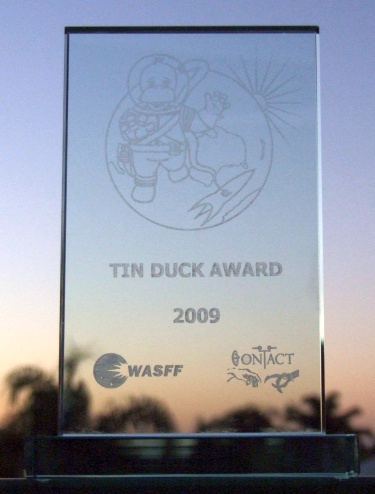
Hal Spacejock No Free Lunch won the WASFF 'Tin Duck' award for best professional long work at Swancon last weekend. This is the second WASFF award in a row for the series, after Hal Spacejock Just Desserts won the same award last year.
It's a very handsome trophy, although it was a real pain to photograph because it's solid glass!
Second bit of news: Big Media coverage!
There was a column in the Weekend Australian on electronic books, and Rosemary Sorensen mentioned the ebook release of Hal Spacejock No Free Lunch.
Third bit of news: Still working on Hal Spacejock 5.
Simon Haynes is the author of the Hal Spacejock and Hal Junior series (Amazon / Smashwords / other formats)
First bit of news: an award!
Hal Spacejock No Free Lunch won the WASFF 'Tin Duck' award for best professional long work at Swancon last weekend. This is the second WASFF award in a row for the series, after Hal Spacejock Just Desserts won the same award last year.
It's a very handsome trophy, although it was a real pain to photograph because it's solid glass!
Second bit of news: Big Media coverage!
There was a column in the Weekend Australian on electronic books, and Rosemary Sorensen mentioned the ebook release of Hal Spacejock No Free Lunch.
Third bit of news: Still working on Hal Spacejock 5.
Simon Haynes is the author of the Hal Spacejock and Hal Junior series (Amazon / Smashwords / other formats)
Thursday, April 09, 2009
Hal 5 update
Just thought I'd take a quick break from tiling, grouting and painting to post a blog about writing. (For once)
One of the reasons I've leapt into decorating with such glee is that it's a great chance to let my mind wander. No deadlines, lots of repetitive work, and a feeling that when I finally get back to writing this novel I'll be able to give it 100%
The other reason is because whole plot lines can appear while you're mixing a bucket of tile adhesive, applying a third coat of varnish to jarrah or slapping acrylic paint onto the walls. (Given that heady cocktail of chemicals and carcinogens, you won't be surprised to hear those plot lines can vanish again just as quickly.)
Anyway, after more than four weeks tiling, decorating, &c, what has my fallow mind come up with? I changed the first name of one of the characers in the book. That's it.
On the plus side, it's a really good name.
Simon Haynes is the author of the Hal Spacejock and Hal Junior series (Amazon / Smashwords / other formats)
One of the reasons I've leapt into decorating with such glee is that it's a great chance to let my mind wander. No deadlines, lots of repetitive work, and a feeling that when I finally get back to writing this novel I'll be able to give it 100%
The other reason is because whole plot lines can appear while you're mixing a bucket of tile adhesive, applying a third coat of varnish to jarrah or slapping acrylic paint onto the walls. (Given that heady cocktail of chemicals and carcinogens, you won't be surprised to hear those plot lines can vanish again just as quickly.)
Anyway, after more than four weeks tiling, decorating, &c, what has my fallow mind come up with? I changed the first name of one of the characers in the book. That's it.
On the plus side, it's a really good name.
Simon Haynes is the author of the Hal Spacejock and Hal Junior series (Amazon / Smashwords / other formats)
Subscribe to:
Posts (Atom)